ProFlex® is designed to optimize your time, ignite your investment IQ, and maximize your financial potential.
Proflex Oct 26–30 — Good Earnings, Bad Market, Max Shorts, Meta
Published 1 day ago • 9 min read
Proflex Market Update — Week Oct 26-30, 2026
Good Earnings, Bad Market | Everyone Is Short | Meta’s Cash Flip | Decision Week
"Analysts have more than doubled their 2026 earnings forecast since December, yet stocks are up only 12%. The market is not doubting the profits. It is charging more for the money, exactly as it did in 2022." — Proflex Panel
The week in 30 seconds ▸ S&P 500 earnings are growing 29.5% this quarter and 83% of companies are beating. The forward P/E has still fallen from 22.5x to 18.7x since December. ▸ Short leverage in Goldman’s prime book is at the 99th percentile of five years. Pessimism is close to an extreme. ▸ Meta beat on revenue and fell 9.4%. Its capex now exceeds its operating cash flow, and we think the new share class is the real worry. ▸ Brent rose 6.2% to $116.72, its highest settle since April. Credit spreads barely moved. ▸ Decision week: the Fed on Wednesday, then Microsoft, Alphabet and Amazon. Watch the full macro call →
The S&P 500 slipped 0.5% last week to 7,624 and the Nasdaq 100 lost 0.8% to 28,958. The semiconductor index fell another 3.2%. Underneath, the rotation kept going: the equal weight S&P rose 1.1% and the Russell 2000 gained 2.0%.
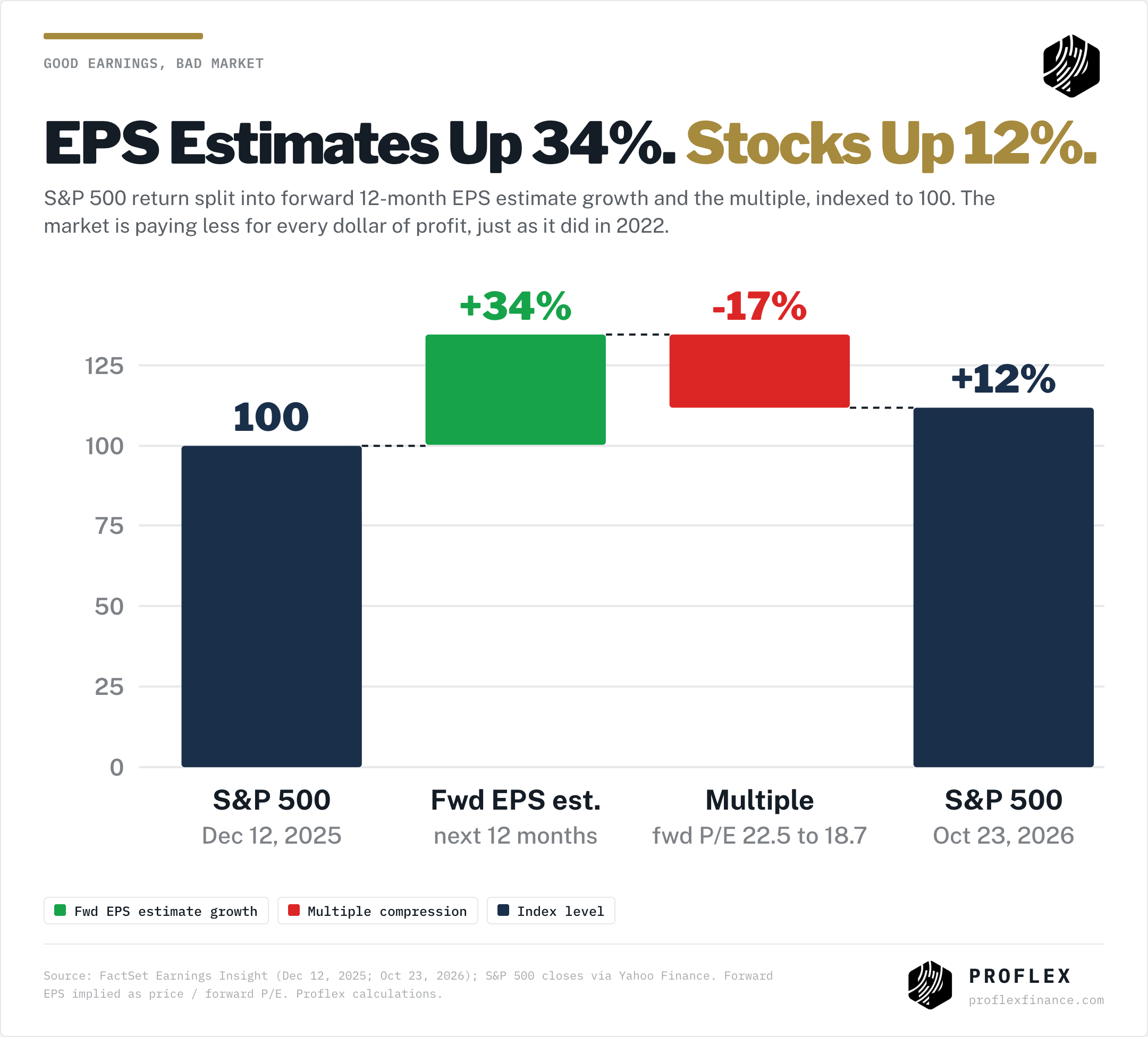
The earnings themselves were strong. FactSet’s blended growth rate for the third quarter climbed to 29.5%, which would be a third straight quarter above 25%. So why is the market falling while profits are booming? This chart explains most of it.
Insights from the Proflex Macro Call
Rotation, not a meltdown. The equal weight S&P is in a steady recovery while tech corrects. Zoomed out, the Nasdaq is still moving sideways in a band and still making higher lows.
This is 2022, not 2001. Fidelity’s data shows 2026 is the best year for earnings since 2018 (2021 aside, a rebound from COVID). In 2022, too, earnings held up while P/E ratios compressed, because the cost of capital was rising. The same thing is happening now, with the 10 year near 5%.
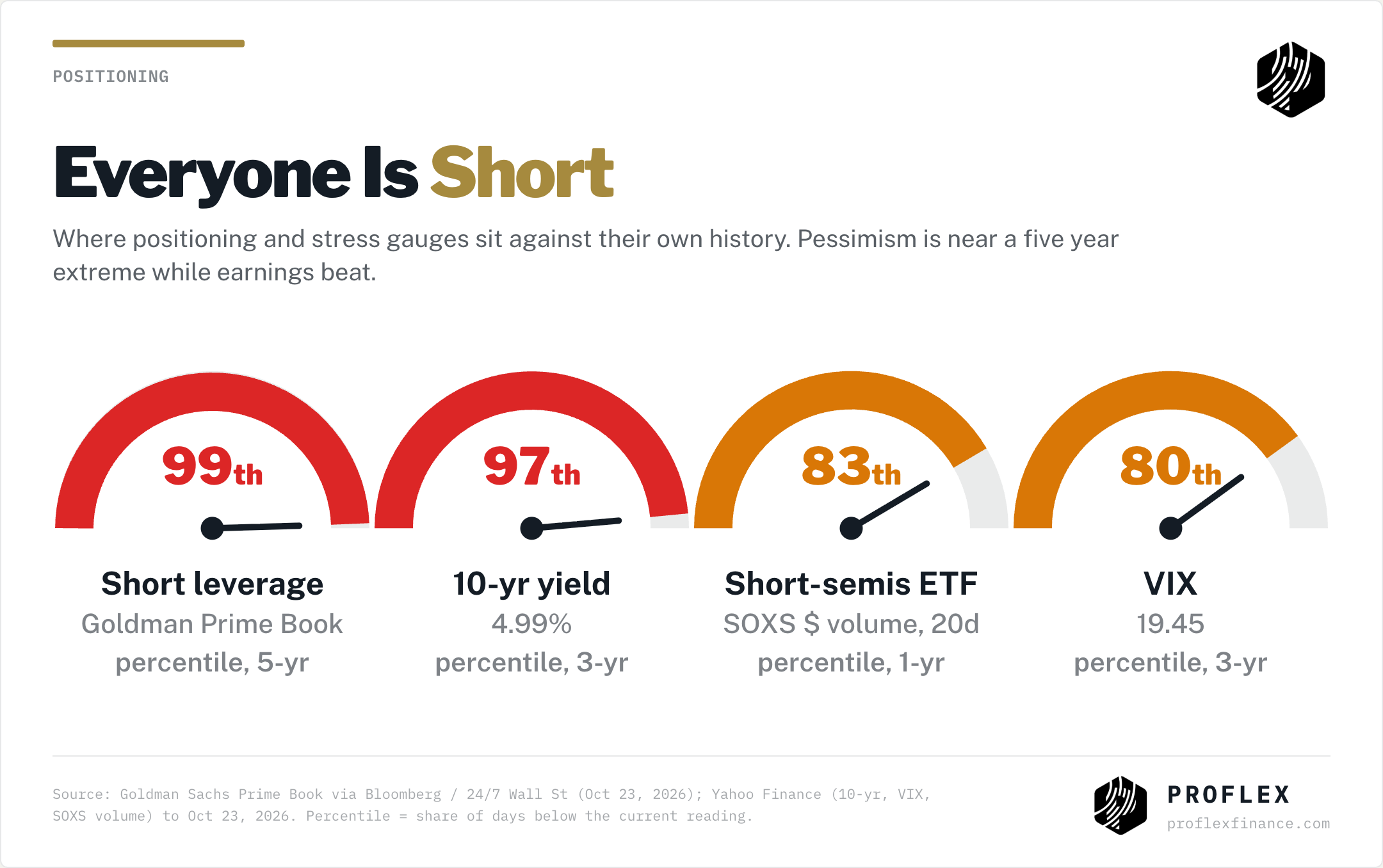
Shorts are at extremes. Goldman’s prime book, short ETF volumes and Jefferies’ data on 20 day hedge fund net outflows, among the worst of the year in October, all point the same way. Extremes can stretch further, but short positions tend to unwind faster than long ones.
Earnings matter more than macro this week. What he wants from the hyperscalers is proof of growth beyond the frontier labs, from open source and enterprise demand. That would counter the Anthropic and OpenAI valuation story.
✅ A falling 10 year lifts equal weight and small caps (called Oct 12–16). The 10 year fell from 5.10% to 4.99%, the equal weight S&P rose 1.1% and the Russell 2000 rose 2.0%. Right this time. ✅ Bitcoin: $80,000 is the floor (called Sep 21–25). Every weekday close stayed above $81,000. Friday: $81,074. Holding. ✅ The QQQ higher low near $705 (Oct 19–23). QQQ dipped to $701 intraday and closed at $704.40, just above its September low close. Held, barely. ❌ SMH holds its September low near $540 (Oct 19–23). It closed at $527.20. Broken. ⏳ Brent at $120 is the correction trigger (called Sep 14–18). Brent settled at $116.72, about 3% away. Closest yet. ⏳ VIX above 20 has been a buying moment in 2026 (Oct 19–23). The 10 day test ends on October 30. The Nasdaq 100 is at 28,958, against 29,188 at the start. Pending.
Key Drivers This Week
Good Earnings, Bad Market: It Is the Multiple
Since mid December, the forward 12-month S&P 500 earnings estimate has risen about 34% while the index has risen 12%. Part of that is the estimate window rolling forward into 2027; the rest is upgrades. Analysts now see 33% earnings growth for 2026, up from 14.5% in December. The difference is the multiple: the forward P/E fell from 22.5x (FactSet, Dec 12) to 18.7x, now below both its five year average of 19.8x and its ten year average of 19.1x. FactSet projects 16% earnings growth for 2027 on top of that.
At Proflex, the comparison we keep coming back to is 2022. Then, too, earnings grew while P/E ratios compressed, because a risk-free rate of 4% to 5% gives investors an alternative. With the 10 year at 4.99%, at the 97th percentile of its three year range, the market is asking for a discount before it takes equity risk.
Proflex View: A falling P/E with rising earnings is not a bubble bursting. It is a valuation reset driven by the cost of capital. Our view since the summer has been that an extra one or two points on the cost of capital does not matter if AI delivers a step change in productivity. The market wants proof first, and this week’s hyperscaler results are where it gets it.
Everyone Is Short
Goldman Sachs’ prime brokerage desk says short leverage in its book has reached the 99th percentile of its five year history, and short sales are running at about five times long purchases across global equities this month (Bloomberg). Fundamental long/short funds are down 2.5% in October, and tech, media and telecom funds are down 7.4%. Trading in the 3x short semiconductor ETF (SOXS) over the last 20 days is at the 83rd percentile of the past year.
Positioning was just as extreme on the other side in April and May, and the rally ran until June. A 99th percentile can become a 100th. The asymmetry is that shorts have to be bought back, and that buying can be fast. We saw a small version last week: SpaceX jumped 7.8% on October 21 after strong results, then gave it back the next day.
Proflex View: Peak pessimism is a setup, not a signal. It does not tell you the day of the low. It tells you what happens if the hyperscalers deliver: shorts at the 99th percentile cover into good news. We would rather be positioned for that than chase it after the first green day.
Meta: Great Quarter, Wrong Kind of Spending
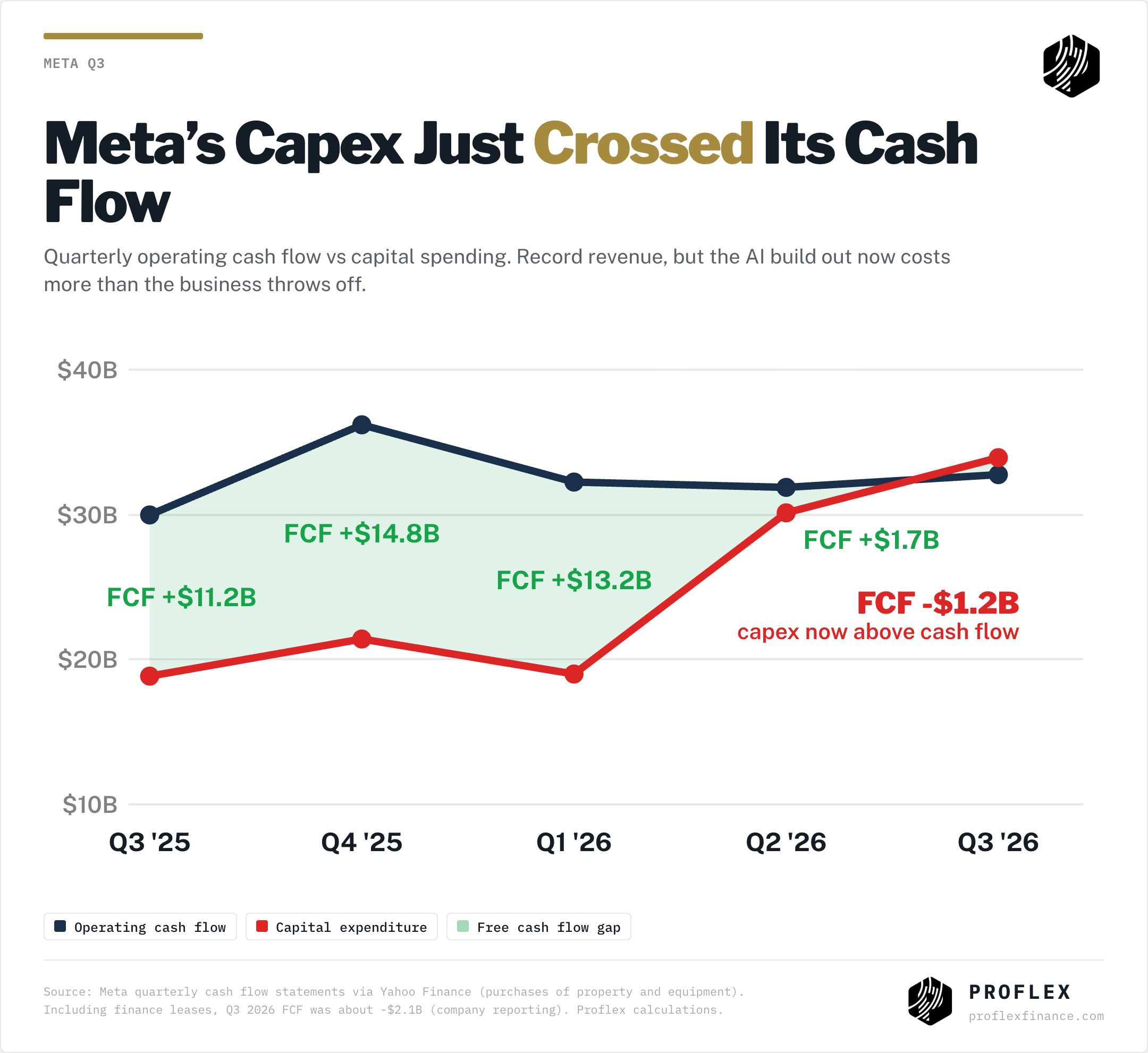
Meta reported record revenue of $64.6 billion, up 26% and ahead of the $63.3 billion consensus. Excluding a $9.9 billion legal charge, EPS was about $7.40. The stock still fell 7% the next day and 9.4% on the week. The cash flow statement shows the problem. Capital spending of about $34 billion in the quarter exceeded operating cash flow of $32.8 billion, and free cash flow turned negative for the first time as a public company. Full year capex guidance is $135 billion to $145 billion.
Our read is that capex was not the reason for the drop. Spending was close to what was expected. The worry was the new non-voting Class C shares, which investors fear will become a tool for selling equity, as Alphabet did with its $80 billion+ raise in June. Reports so far describe the Class C shares as a stock dividend, not a capital raise, so treat that as a risk, not a fact.
Proflex View: This is the shift to watch in big tech. For a decade these companies bought back their own stock. Now the build out is large enough that some of them may have to issue it. When the biggest buyers of a stock become sellers, the multiple takes the hit even when the quarter is great. We favour the companies that fund the build out from their own cash.
The AI Chips Now Trade Below the Market
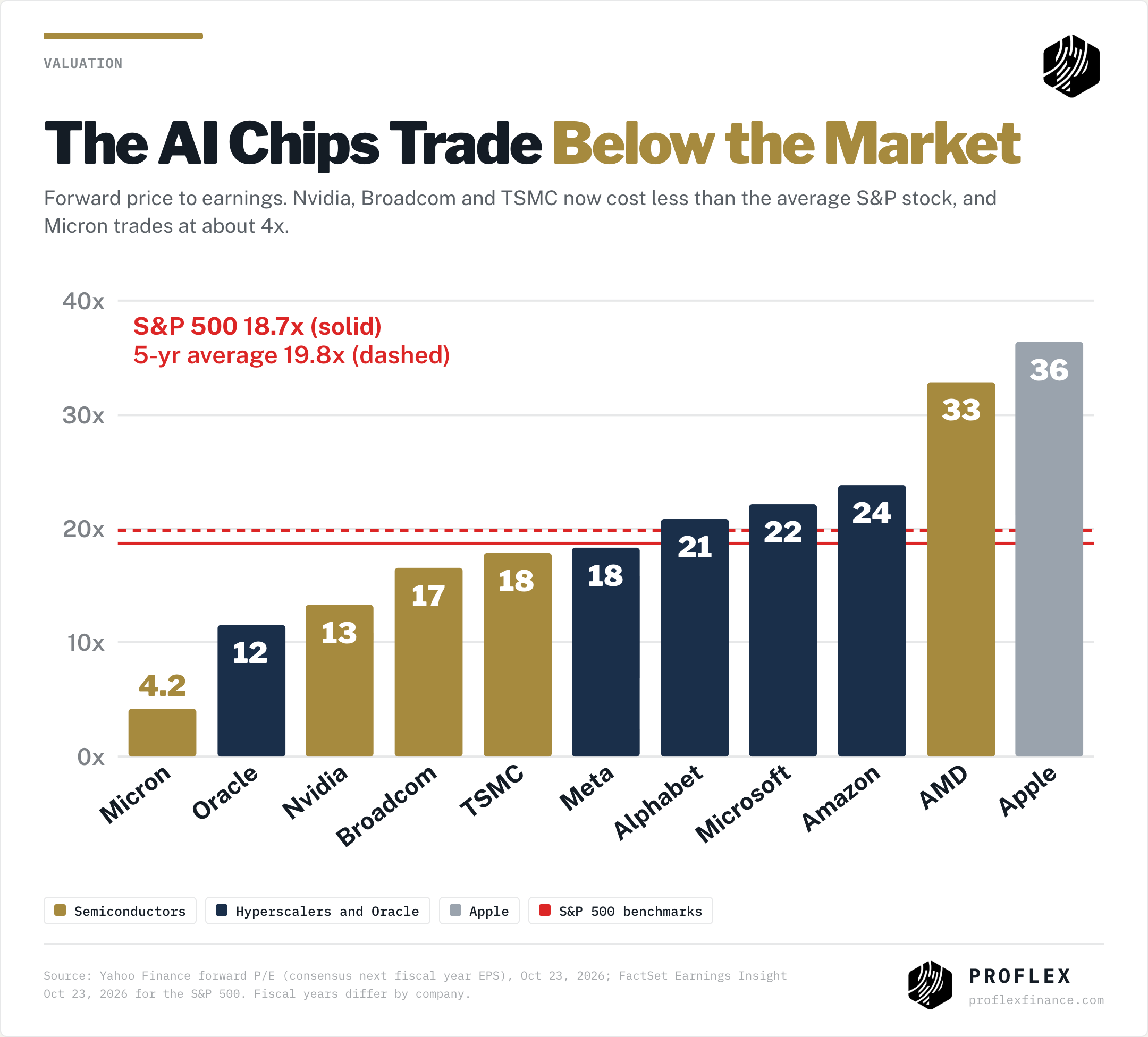
The irony of the selloff is where it has left valuations. Nvidia trades at about 13 times forward earnings, Broadcom at 17 and TSMC at 18. All three are below the S&P 500’s 18.7x. Micron trades at about 4 times, a multiple that assumes the current memory boom will collapse. These companies are not dependent on debt: they are the ones being paid for the build out.
Put median megacap valuations today next to the levels after the Cisco crash in 2000 and the gap is striking. The market is already pricing in a version of the bubble bursting. On October 13 the semiconductor ETF was about 10% higher than it is today. Narratives change quickly in this cycle, in both directions.
Proflex View: When the companies that sell the picks and shovels trade at a discount to the market, a lot of bad news is already in the price. We would add to the cash generative chip leaders on weakness and keep the debt funded builders smaller. They are still the most leveraged way to own this theme.
Macro: Oil Near $120, Credit Calm, Fed on Hold
Brent rose 6.2% to settle at $116.72 on Friday, its highest settle since April 29, after Houthi claims of strikes on Saudi energy sites (GV Wire, Bloomberg). Saudi Arabia has not confirmed damage. Since mid September we have named Brent at $120 as the trigger for a real correction. It is now about 3% away.
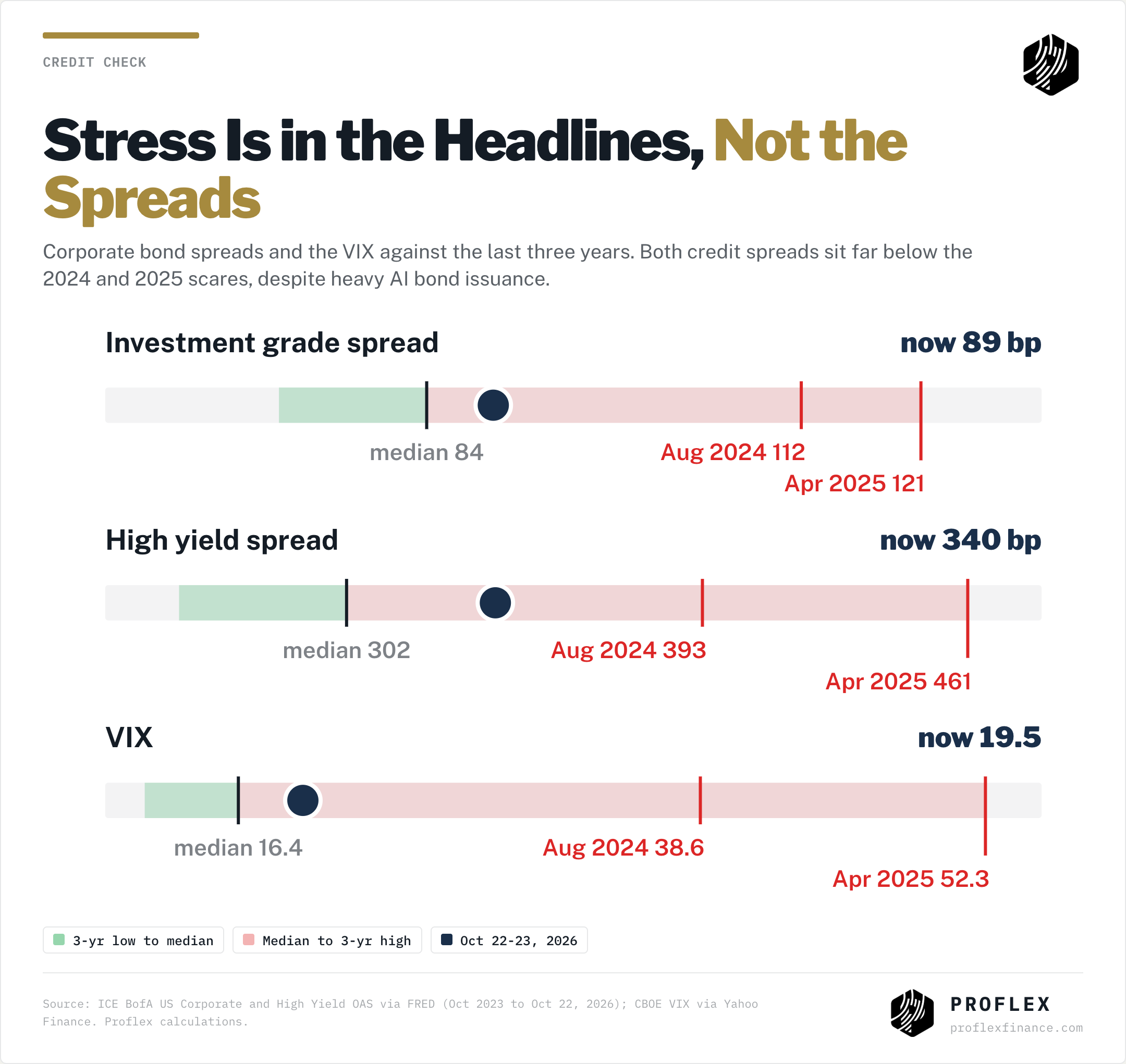
The bond market tells a calmer story than the headlines. Investment grade spreads were 0.89% on Thursday, near their three year median and well below the 1.21% of April 2025 (ICE BofA via FRED). High yield spreads, at 3.40%, are far from the 4.61% of the same scare. In late July we wrote that the fundamentals did not break, the leverage did. The neocloud bond scare looks like the same pattern: lower quality debt repricing as Alphabet, Amazon and SpaceX flood the market with higher quality supply.
CME FedWatch now prices roughly a 90% chance of a hold on Wednesday, down from about 41% after the hot CPI print on October 14. A hike by December is about 87% priced. We also said that a falling 10 year would give the equal weight index room to catch up. This week it did: the 10 year fell 11 basis points and small caps led. Bitcoin held its ground near $81,000, and gold fell 4.1% to $4,008.
Proflex View: The macro picture is tight, not broken. Spreads over Treasuries are normal, but Treasuries themselves now yield 5%, and that is what is compressing multiples. A December hike is mostly priced. The risk that is not priced is Brent through $120. That is the one macro trigger that would turn this valuation reset into a deeper correction.
🔍 What We’re Watching
The Fed on Wednesday, October 28. Watch the statement for the December hike, not the decision itself
Microsoft and Alphabet midweek, then Amazon. The tell is cloud growth beyond the frontier labs, and whether Alphabet says anything about further equity sales
Q3 GDP and September PCE on Thursday, October 29
Brent against $120, and SMH reclaiming $540
QQQ holding $700, and Bitcoin holding $80,000
The Anthropic IPO, expected in mid November, and where it prices against the $1.5 trillion to $2 trillion being discussed
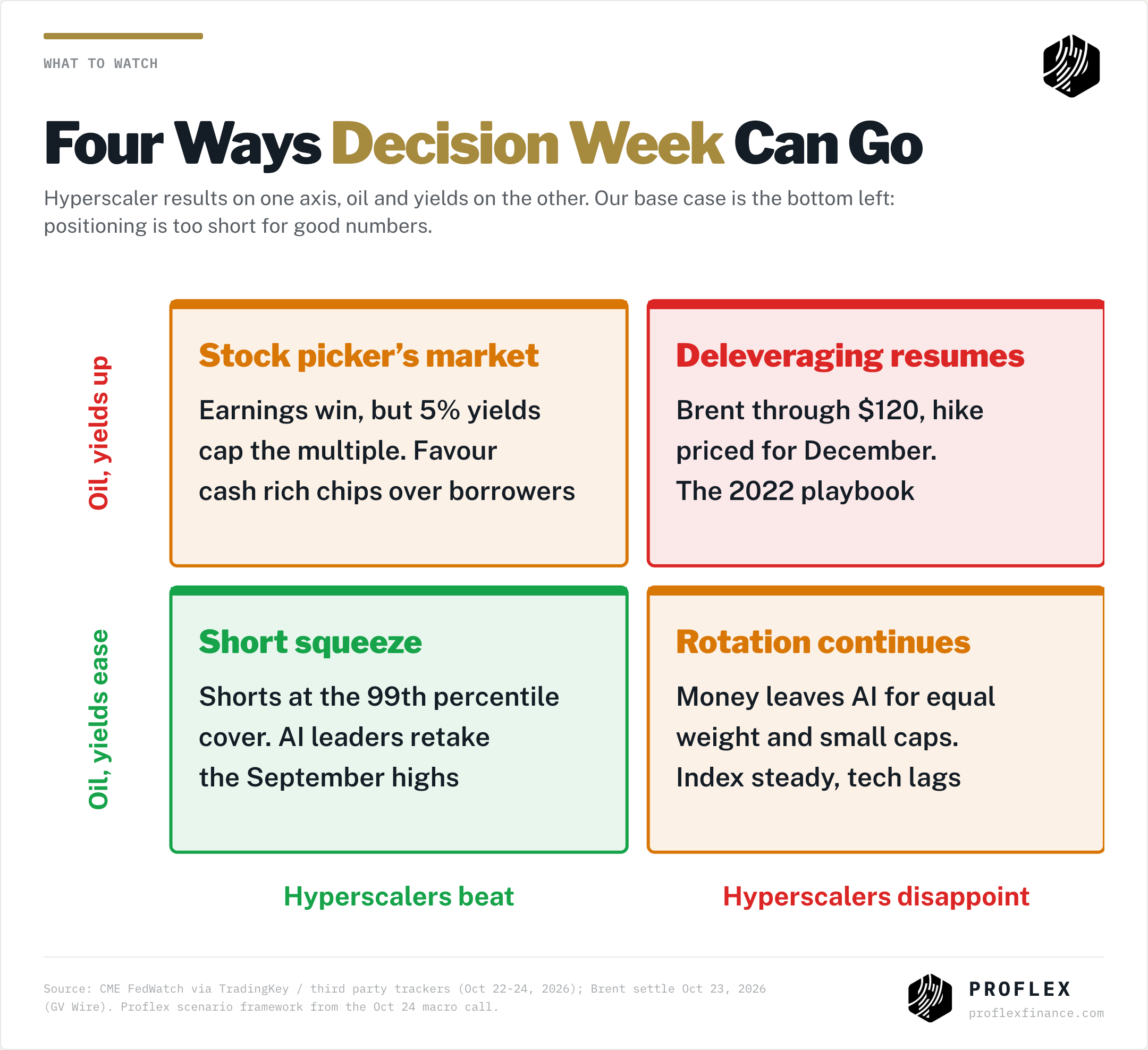
Your turn: Which quadrant do you think we land in by Friday? Hit reply with one word: squeeze, picker, rotation or deleveraging. We will share the tally in next week’s edition.
🧭 Proflex Playbook – Own the Earnings, Respect the Cost of Capital Earnings are growing at their fastest pace since 2018, and the market is paying less for them because 5% Treasuries are a real alternative. That is the 2022 setup, with one difference: positioning is already near a five year bearish extreme. Favour the businesses that fund their own build out, size the borrowers smaller, and let this week’s hyperscaler results, not the headlines, decide how much risk to add. Our conviction stays anchored in the data:
Focus on Structural Growth: Continue to overweight the secular AI theme, recognizing its multi-year runway.
Anticipate Shallow Corrections: Use dips as accumulation opportunities, not reasons for fear, understanding that "none of the corrections stick."
Diversify Thoughtfully: Recognize the "decorrelation" across asset classes; consider gold, silver and Bitcoin for portfolio resilience.
Develop Mental Models: Prioritize long-term planning (6-12 months out) over short-term news, aiming for consistent, incremental gains.
If you're an All-Access or Managed Portfolio subscriber, our positioning has already shifted ahead of this moment—scaling up asymmetric hard asset plays while hedging for earnings volatility and geopolitical tail risks.
Proflex All-Access: Your Market Compass
Explore the financial markets with Proflex All-Access, your comprehensive resource for deeper market understanding and active participation. This premium service offers subscribers exclusive insights and actionable investment advice, giving you a significant edge in various market conditions.
Proflex All-Access provides detailed analyses and recommendations to optimize your investment strategy. Our specialized newsletters include:
• Growth Gazette (Contains Crypto Pulse) : Aimed at achieving above-market returns for aggressive portfolio growth.
• Income Insider: Focused on conservative strategies and income generation for yield-seeking investors.
Until next week, — The Proflex Team Trusted Macro Insights. Calm Investing. Tactical Trades.
Elevate your financial IQ
ProFlex® by Blockstart Research Legal Disclosures
ProFlex® by Blockstart Research, the premium newsletter product series, provides informational and educational content only and does not offer personalized investment advice or establish a fiduciary relationship. While we rely on reliable sources and research, the information is not tailored to individual financial situations. Readers are urged to consult qualified financial professionals before making investment decisions. We do not guarantee the accuracy, completeness, or timeliness of the information and are not responsible for any investment decisions based on this newsletter. Investing carries risks, and past performance doesn't predict future results. By accessing this newsletter, you acknowledge that we are not liable for actions or decisions resulting from its content. Please conduct due diligence and seek professional advice as needed.
Proflex Institutional Research Series
Elevate Your Investment Game!
ProFlex® is designed to optimize your time, ignite your investment IQ, and maximize your financial potential.