ProFlex® is designed to optimize your time, ignite your investment IQ, and maximize your financial potential.
Proflex Oct 12–16 — Rotation Not Correction, OpenAI $50B vs $70B, 5.3% Is the New 5%
Published about 14 hours ago • 12 min read
Proflex Market Update — Week Oct 12-16, 2026
Rotation, Not Correction | The $50B Headline That Wasn’t | 5.3% Is the New 5% | Diesel, the Black Swan
"One misread revenue headline took 4% off the semis, and the equal weight index still rose. This market is not correcting. It is rotating, and it is too leveraged to sit still." — Proflex Panel
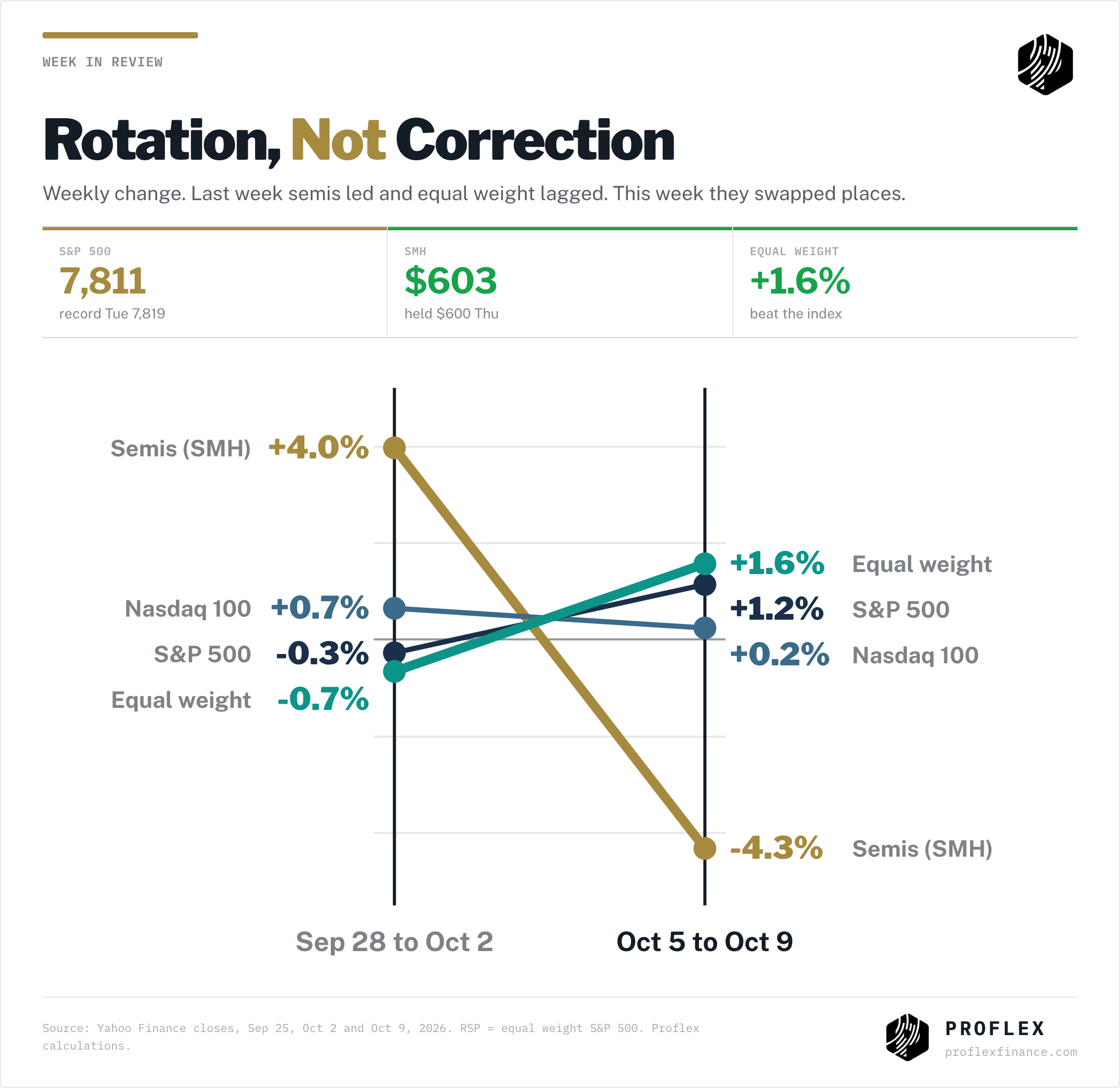
The S&P 500 closed at a record 7,818.93 on Tuesday and the Nasdaq 100 set its own record at 31,224 the same day. Then on Thursday the Financial Times reported that OpenAI’s annualized revenue was near $50 billion, not the $70 billion the market had been told. The semiconductor ETF fell 2.8% that day, touched $600.32 and finished the week at $603.33, down 4.3%.
Everything else held up. The S&P still finished the week up 1.2% at 7,811. The equal weight S&P rose 1.6%. A strong 10 year auction pulled the yield back to 5.24%. And by Friday the FT had added an update: the $50 billion was net revenue, the $70 billion was gross. Two figures for the same business, counted two ways.
The question for this week is not whether the AI trade is over. It is whether the semis hold $600 through CPI on Wednesday and TSMC on Thursday, while the rest of the market keeps doing the work.
Insights from the Proflex Macro Call
This is rotation, not a correction. Raman’s read is that money did not leave the market this week, it moved. The selling was concentrated in semis and the AI hardware names, while the equal weight index and the wider market caught a bid for the first time in a month. The two levels he is watching are $600 on SMH and the 30,800 double top on the Nasdaq 100. Both held.
$50 billion is not bad news. Six months ago the market asked whether AI had any revenue at all. This week $50 billion was treated as a disappointment while Anthropic is pacing above $100 billion. That puts the two frontier labs alone above $150 billion, before counting the open source demand that flows to the hyperscalers, which report in two to three weeks.
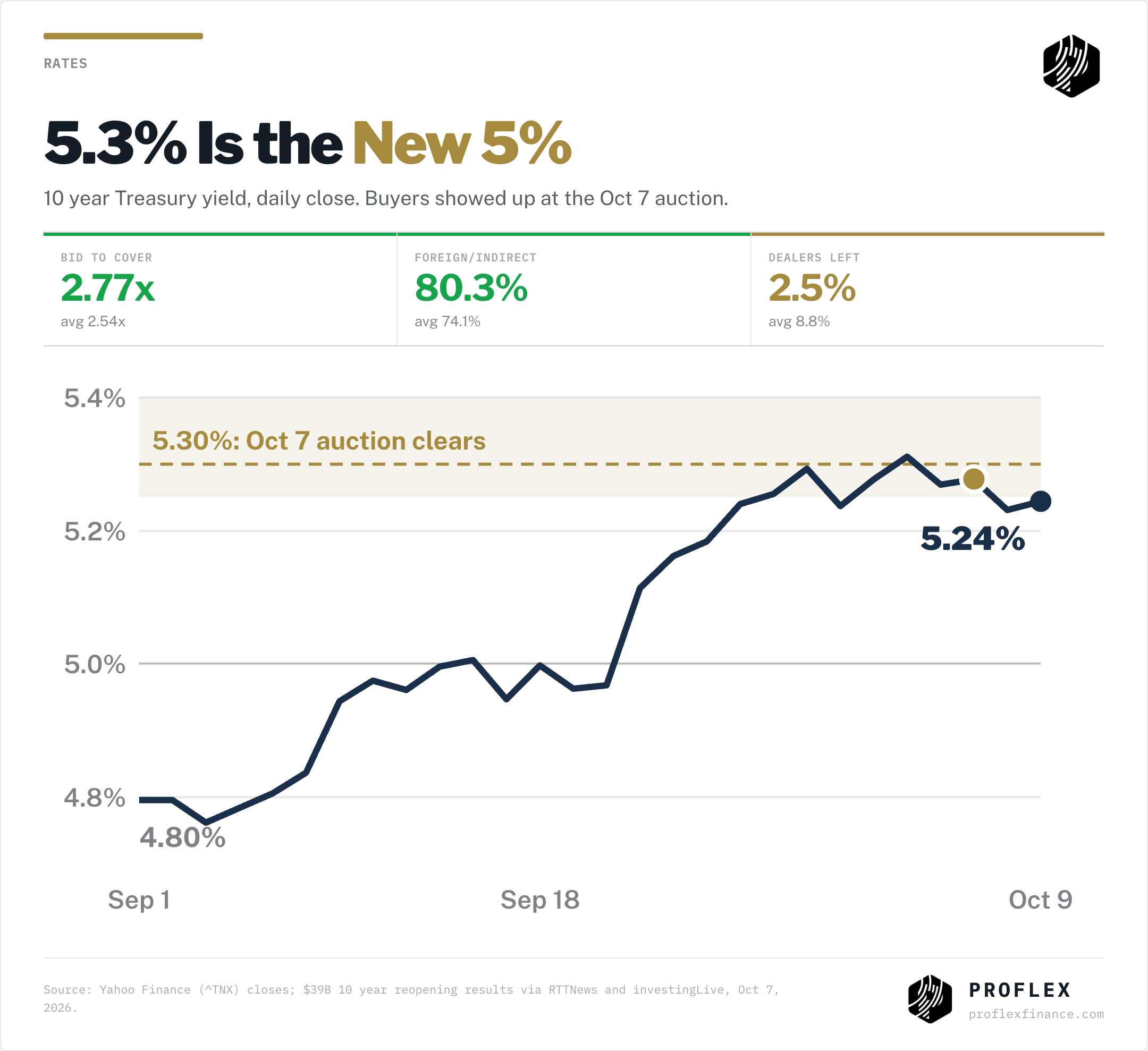
5.3% is the new 5%. Last week the bond market was the threat. This week the 10 year auction found real demand at 5.3%, and Raman’s point is simple: if investors are willing to lock in a risk free 5.3% for ten years, that level is becoming a ceiling, not a launch pad.
Oil is the black swan. Iranian attacks on tankers, a Gulf hurricane and record diesel prices have the White House firefighting, including buying Russian diesel. If inflation comes back into the story, the rate hike debate reopens. Raman expects the Fed to hold on October 28, one week before the midterms, which is what the market is pricing.
A leveraged market judges AI every day. The utility is not in question. Token costs are falling with every hardware generation, and AI is splitting into separate trades: power, memory, GPUs, CPUs and networking. But leverage is high and capex is high, so one headline produces a sharp drawdown. For traders that is opportunity. For buy and hold investors, Raman’s advice is to stop watching the daily tape.
Money creation keeps the rally alive. With rates high and the Treasury leaning on short term bills, money supply has to keep growing. Raman’s view is that this, plus AI driven productivity, is the only way out of the macro bind short of the Japan template. Either way it means more money chasing assets, which is why these rallies do not die quickly.
✅ SMH above $600 confirms AI leadership (called Sep 21–25). Tested on Thursday with a low of $600.32, closed the week at $603.33. Holding. Right. ✅ The discounted leaders need to join in (called Sep 28–Oct 2). Amazon +4.3%, Microsoft +3.4% and Alphabet +2.4% this week, and the S&P made a record. Right. ✅ Watch the equal weight September low (called Oct 5–9). RSP finished 2.4% above its Sep 30 low and outran the S&P. Right. ✅ Bitcoin: $80,000 is the level to watch (called Sep 21–25). It cleared it in late September, and Thursday’s low of $80,337 held as support. Right. ⏳ Brent at $120 is the correction trigger (called Sep 14–18). Brent closed at $104.72. Not reached. Holding as our line. ❌ A stumble in a leader hits the index hardest (called Oct 5–9). The AI chip leaders fell 4.3% on one headline and the S&P still rose 1.2%. The broad market absorbed it. Wrong, and a good kind of wrong.
Key Drivers This Week
Rotation, Not Correction
Two weeks ago we said a close above $600 on the semiconductor ETF was the level that confirms the AI trade is leading again. This week that level was tested for the first time. SMH fell from $633.90 on Monday to an intraday low of $600.32 on Thursday, and closed every day above it.
The money went somewhere. Last week we said that for the S&P to break out, the discounted leaders just needed to join in. This week they did: Amazon rose 4.3%, Microsoft 3.4% and Alphabet 2.4%, while Nvidia fell 2.0% and Micron 4.3%. We also said to watch whether the equal weight S&P held its September low. It finished 2.4% above it. The Nasdaq 100 dipped to 30,726 on Thursday and reclaimed 30,883 on Friday, back above the 30,800 double top. The Russell 2000 was the exception, down 0.9% on the week.
Proflex View: A correction takes money out of the market. A rotation moves it around inside it. This week was the second. As long as SMH holds $600 and the Nasdaq 100 holds 30,800, the AI leaders are consolidating a breakout, not rejecting it. A close below $600 changes that read.
The $50 Billion Headline That Wasn’t
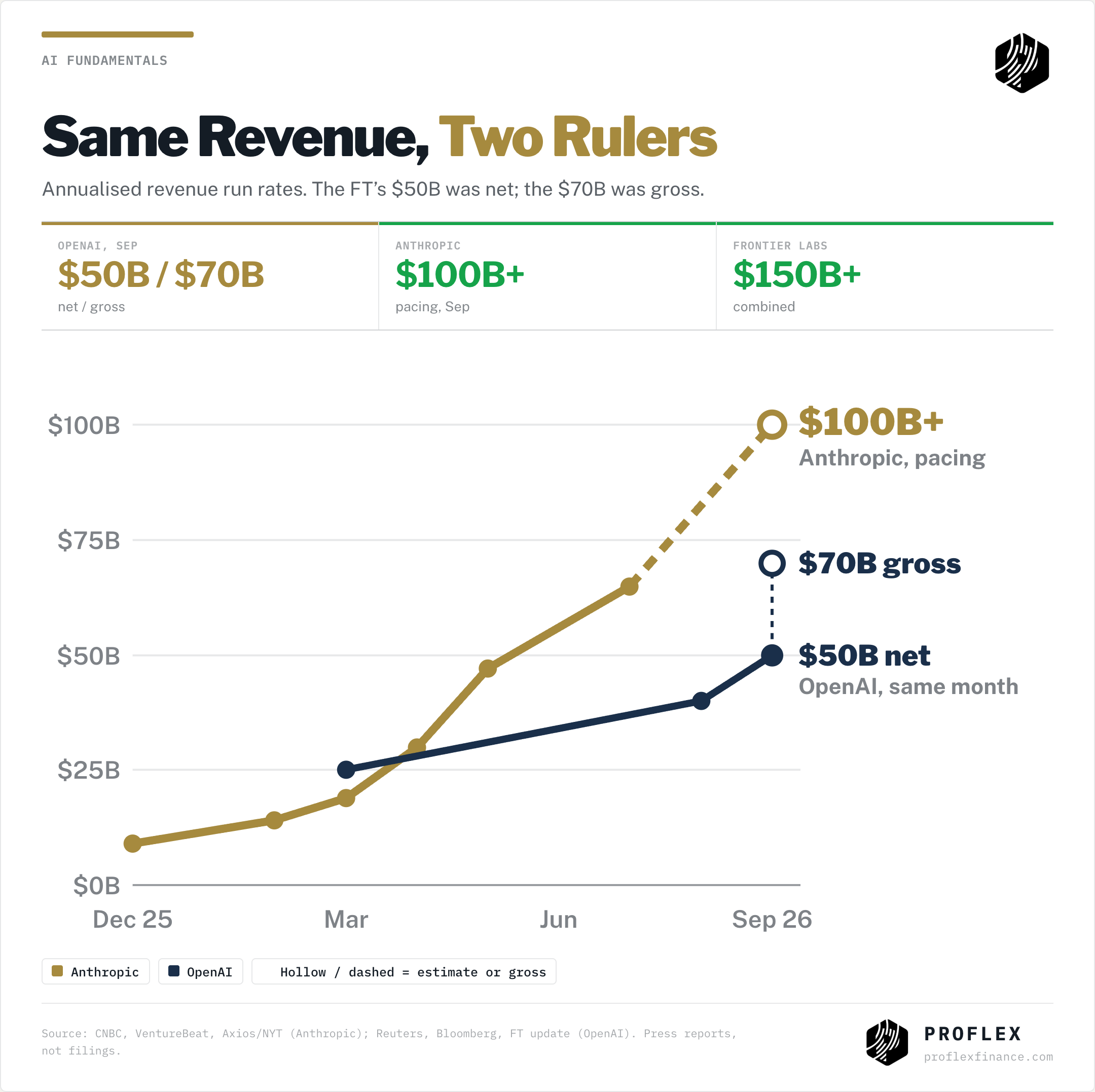
On Thursday the FT reported that OpenAI had told investors its annualized revenue was near $50 billion at the end of September, about $20 billion below the figure reported in late September (Financial Times, Reuters). Nvidia fell 3%, Micron 4.8% and Oracle 5.5% that day.
The gap is accounting. Anthropic counts sales made through cloud partners like AWS and Google Cloud as revenue. OpenAI does not. The FT’s later update put OpenAI’s September revenue at $50 billion net and $70 billion gross, and Bloomberg reported that OpenAI expects to reach or exceed $70 billion by year end. Anthropic, on the same gross basis, went from about $9 billion at the end of 2025 to $65 billion in July and is pacing above $100 billion (CNBC, Axios, NYT).
The other headline was Meta. A third party analysis published Friday showed downloads of Meta’s Muse app fell 8.1% week over week. The publisher disclosed a short position in Meta, and downloads do not measure usage, especially for an assistant that also lives inside WhatsApp. Meanwhile the cost of producing that intelligence keeps falling: Nvidia claims up to 35 times lower cost per token on Blackwell than on Hopper.
Proflex View: Markets punished a definition, not a slowdown. Whether you use $50 billion or $70 billion, OpenAI’s revenue has grown sharply this year, and the two frontier labs together are above $150 billion. The real test arrives in two to three weeks when Microsoft, Alphabet and Amazon report cloud growth, which will show how much of the open source demand is landing with the hyperscalers.
AI Is No Longer One Trade
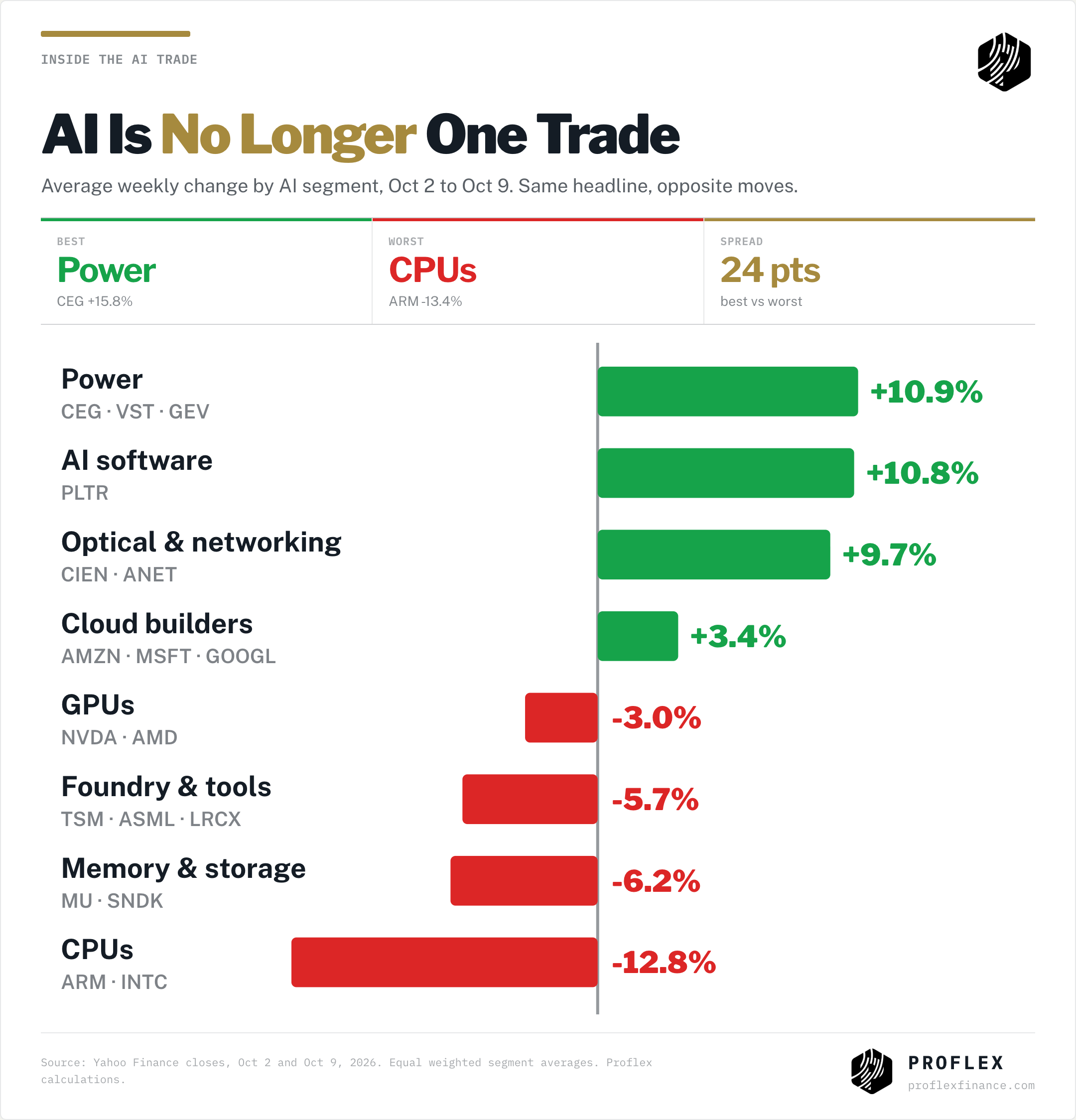
Look inside the AI trade this week and there is no single AI trade. Power names rose an average of 10.9%, led by Constellation Energy at +15.8% and Vistra at +15.3%. Optical and networking rose 9.7%, with Ciena up 14.9%. At the other end, CPU names fell 12.8%, with Arm down 13.4%, and memory and storage fell 6.2%.
That is a 24 point spread inside one theme in one week, on one headline. It is why Proflex is breaking AI into separate segments for subscribers this month, including a full analysis of who actually benefits on power when every new data center needs a grid connection.
Proflex View: The demand is real, so the question has moved from “is AI working” to “where in the chain is the money landing.” This week the market paid for the physical bottlenecks, meaning power and the optical links between clusters, and sold the chips most exposed to a funding scare. Expect that dispersion to stay high into earnings.
5.3% Is the New 5%
The Treasury sold $39 billion of 10 year notes on October 7 at 5.300%, below the 5.317% where the notes traded before the auction. Bid to cover was 2.77x against a 2.54x average, foreign and other indirect buyers took 80.3%, and dealers were left with just 2.5% against a usual 8.8% (RTTNews, investingLive). The 10 year closed the week at 5.24%, down from 5.31% on Monday.
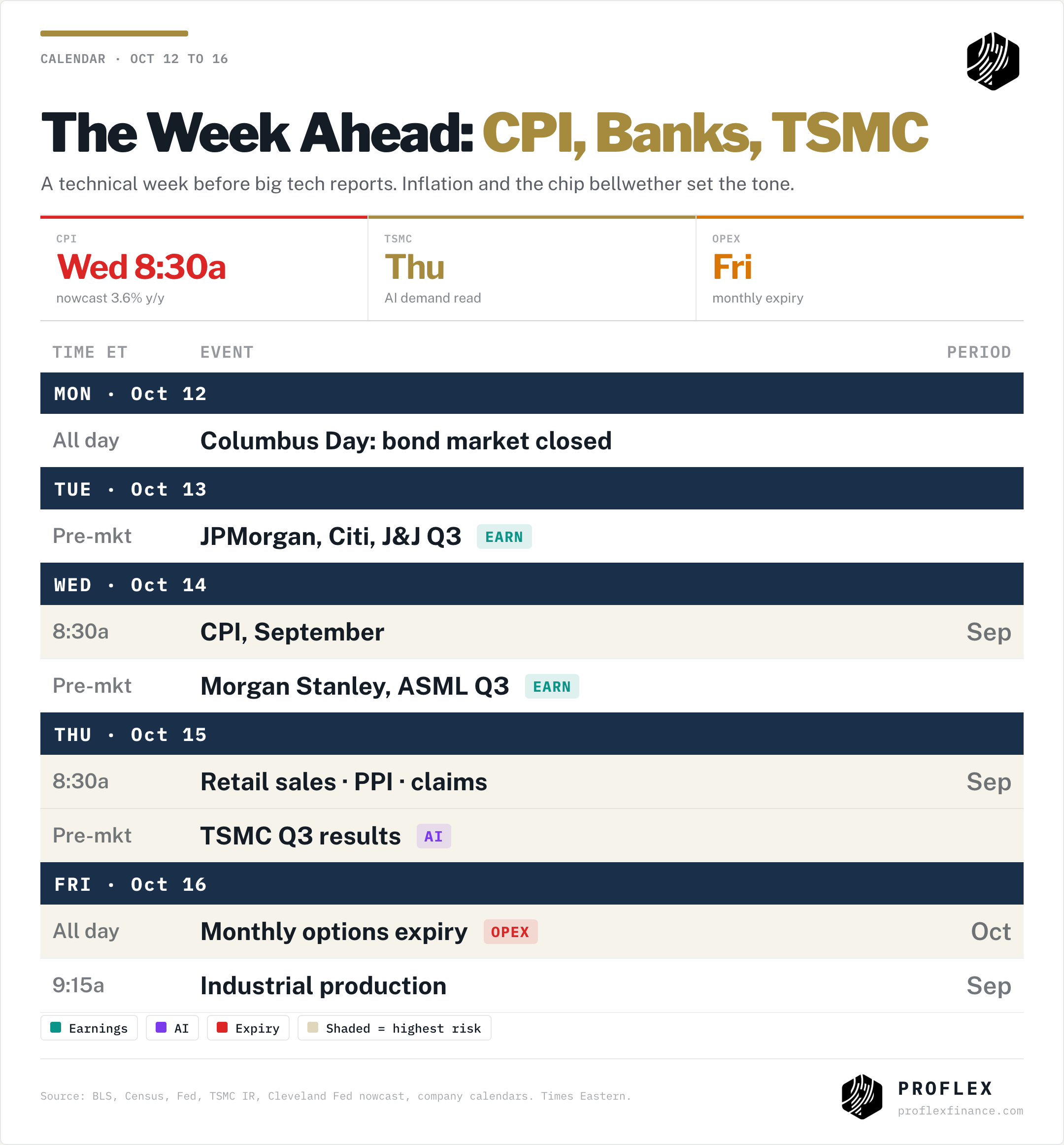
Last week we said a new high above 5.34% on the 10 year would test equities harder. It never came. The FOMC minutes showed most members expect another hike would likely be appropriate by year end, yet CME FedWatch has October hike odds down to about 18% (from roughly 36% a week earlier) since the 29,000 September payrolls print. The Fed meets October 27 to 28 with the funds rate at 3.75% to 4.00%. Wednesday’s CPI is the next test: the Cleveland Fed nowcast has headline inflation at 3.6% year on year.
Proflex View: A 5.3% risk free rate attracting this much demand is a sign of stability, not stress. The further the 10 year falls from 5.3%, the more room the equal weight index and small caps have to keep catching up. Over the longer run, a Treasury that keeps funding itself with short term bills means faster money supply growth, and that supports asset prices even with rates high.
Diesel: The Black Swan
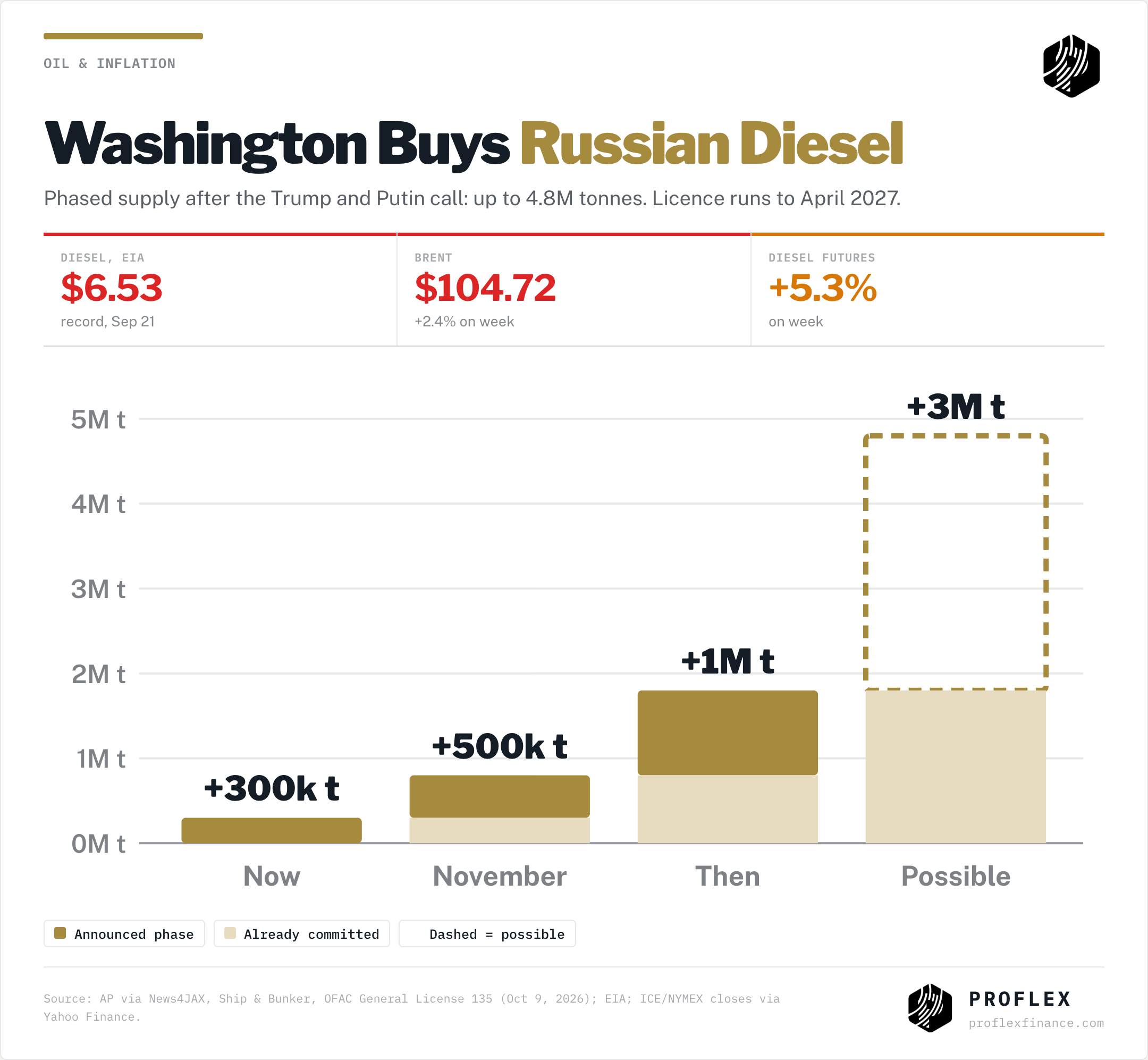
Brent rose 2.4% to $104.72 and diesel futures jumped 5.3%. Reuters counted at least a dozen attacks on tankers around Hormuz from late September into October, the most since the war began. Ahead of Hurricane Isaias, forecast to make landfall on Friday, about 1.3 million barrels a day of Gulf output was shut in, with six refineries in its path. US retail diesel hit a record $6.53 a gallon in September (EIA).
On Friday President Trump said the US would buy Russian diesel after a call with Vladimir Putin: 300,000 tonnes now, 500,000 in November, 1 million after that and possibly 3 million more. Treasury issued a licence allowing the trades through April 7, 2027 (AP, Ship & Bunker).
Proflex View: Diesel moves trucks, farms and freight, so it feeds inflation faster than gasoline does. Washington is clearly willing to do almost anything to bring it down before November 3. Since mid September we have named Brent at $120 as the trigger for a real correction. It is $104.72. Below $120 we read oil as an inflation nuisance; above it, the rate hike debate reopens.
Hard Assets: Gold Steadies, Bitcoin Holds $80,000
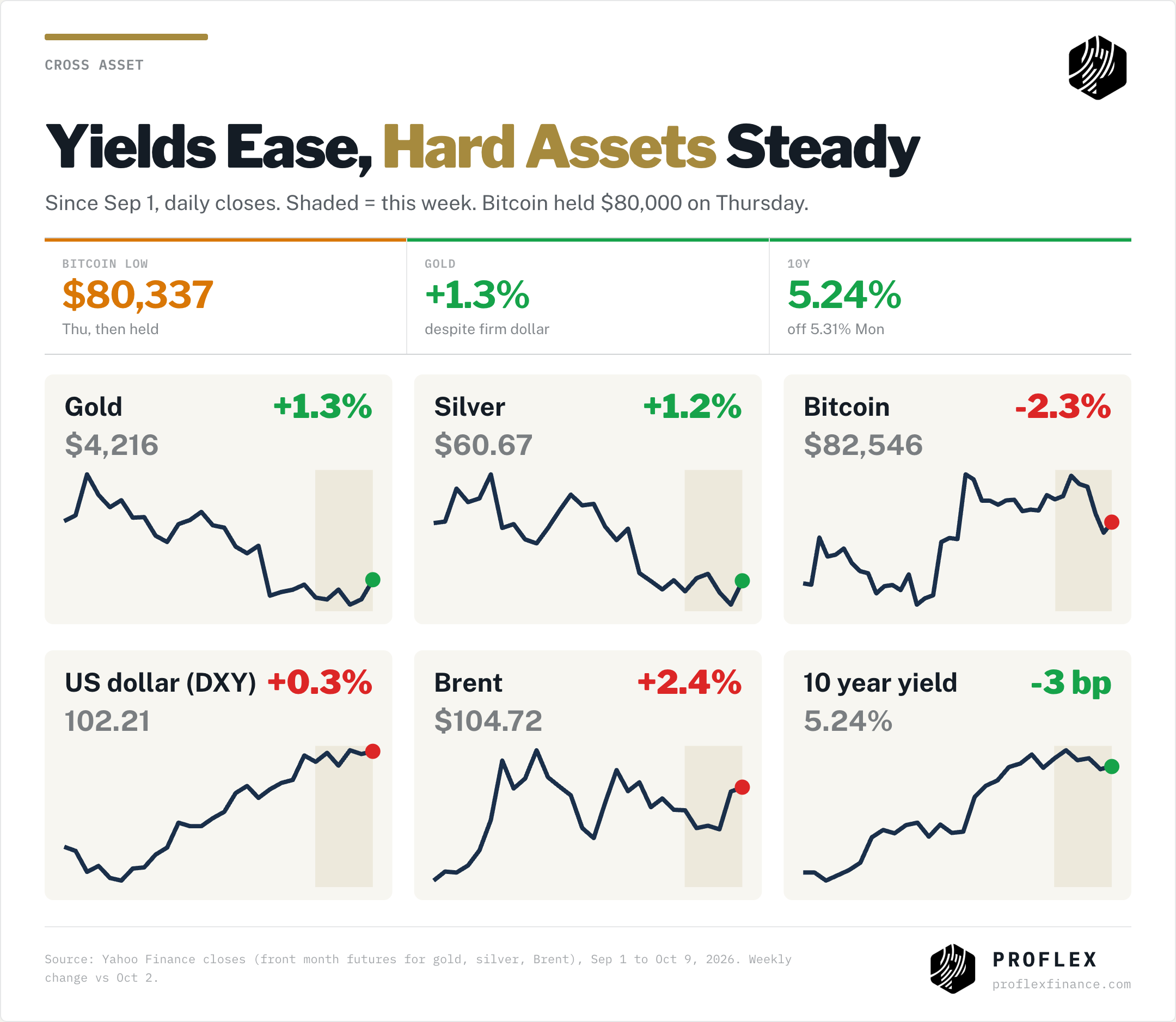
Gold rose 1.3% to $4,216 and silver 1.2% even as the dollar firmed 0.3%. Falling yields gave them room after weeks of pressure from a strong dollar. Bitcoin fell 2.3% to $82,546, but its Thursday low of $80,337 held. In September we said $80,000 was the level to watch on Bitcoin. It broke above it on September 21 and has now defended it as support. Raman now frames an $82,000 to $98,000 range, with $80,000 as the psychological floor.
On crypto policy, the CLARITY Act failed a Senate cloture vote 49 to 50 on September 15, but regulators are moving anyway on tokenization. Asked on the call whether AI agents will pay each other on crypto rails, Raman expects trusted platforms to move first. X Money launched in the US in July, and Apple Pay, Google Pay and Meta all have wallets. Stablecoins, at roughly $300 billion, can handle settlement, but instant and irreversible is a drawback when an agent makes a mistake.
Proflex View: If gold and silver keep turning higher as yields ease, hard assets and Bitcoin can turn together. Bitcoin’s job this week is simple: hold $80,000 to $82,000. A weekly close below $80,000 would break the structure we have leaned on since September.
What This Means For Positioning
Stable index, volatile names. As Raman noted, this year the AI trade has boomed and busted twice in nine months, and individual tech names have corrected hard while the headline index made records. Expect more of the same. The volatility is in the stocks, not the index.
Use the leverage, do not fear it. A market this leveraged dumps good businesses on single headlines. Those are the moments to add or take profit. Growth Gazette members booked most of the premium on a Meta covered call on Thursday, a day before the Muse download data came out. That is the kind of trading this market rewards.
Own segments, not the label. Power and optical rose while CPUs fell. “AI exposure” is no longer a strategy. Know which part of the chain each holding is paid by.
Two technical weeks, then earnings. There is little news until big tech reports, so price levels will drive the market: $600 on SMH, 30,800 on the Nasdaq 100 and 5.3% on the 10 year.
Proflex View: Raman’s closing point from the call is the one to hold onto: the best rallies happen while people are still pessimistic. Every day brings a new “AI is a bubble” headline, and the market keeps making records anyway. Do not call the market irrational because it disagrees with you. Prices are real, and over the long run the view plays out.
🔍 What We’re Watching
SMH against $600 and the Nasdaq 100 against 30,800. A break of either turns the rotation into a correction
September CPI on Wednesday: the nowcast is 3.6% year on year. A hot print puts an October 28 hike back in play
TSMC on Thursday, the cleanest read on AI chip demand after the OpenAI scare
Bank earnings from JPMorgan and Citi on Tuesday, plus retail sales on Thursday, for a read on the consumer at 5.3% rates
Brent against $120 and diesel after the Russian supply deal
Bitcoin holding $80,000, and the Anthropic IPO timetable for November
🧭 Proflex Playbook – Rotation Is the Name of the Game The index is steady while individual names swing 10% to 15% in a week. That is rotation, not a breakdown. Size positions so a headline cannot force a sale, use the leverage driven drops to add to the businesses whose revenue keeps showing up, and judge the AI build out on a 6 to 12 month view, not a daily one. Our conviction stays anchored in the data:
Focus on Structural Growth: Continue to overweight the secular AI theme, recognizing its multi-year runway.
Anticipate Shallow Corrections: Use dips as accumulation opportunities, not reasons for fear, understanding that "none of the corrections stick."
Diversify Thoughtfully: Recognize the "decorrelation" across asset classes; consider gold, silver and Bitcoin for portfolio resilience.
Develop Mental Models: Prioritize long-term planning (6-12 months out) over short-term news, aiming for consistent, incremental gains.
If you're an All-Access or Managed Portfolio subscriber, our positioning has already shifted ahead of this moment—scaling up asymmetric hard asset plays while hedging for earnings volatility and geopolitical tail risks.
Proflex All-Access: Your Market Compass
Explore the financial markets with Proflex All-Access, your comprehensive resource for deeper market understanding and active participation. This premium service offers subscribers exclusive insights and actionable investment advice, giving you a significant edge in various market conditions.
Proflex All-Access provides detailed analyses and recommendations to optimize your investment strategy. Our specialized newsletters include:
• Growth Gazette (Contains Crypto Pulse) : Aimed at achieving above-market returns for aggressive portfolio growth.
• Income Insider: Focused on conservative strategies and income generation for yield-seeking investors.
Until next week, — The Proflex Team Trusted Macro Insights. Calm Investing. Tactical Trades.
Elevate your financial IQ
ProFlex® by Blockstart Research Legal Disclosures
ProFlex® by Blockstart Research, the premium newsletter product series, provides informational and educational content only and does not offer personalized investment advice or establish a fiduciary relationship. While we rely on reliable sources and research, the information is not tailored to individual financial situations. Readers are urged to consult qualified financial professionals before making investment decisions. We do not guarantee the accuracy, completeness, or timeliness of the information and are not responsible for any investment decisions based on this newsletter. Investing carries risks, and past performance doesn't predict future results. By accessing this newsletter, you acknowledge that we are not liable for actions or decisions resulting from its content. Please conduct due diligence and seek professional advice as needed.
Proflex Institutional Research Series
Elevate Your Investment Game!
ProFlex® is designed to optimize your time, ignite your investment IQ, and maximize your financial potential.