ProFlex® is designed to optimize your time, ignite your investment IQ, and maximize your financial potential.
Proflex Nov 2–6 — The Great De-Grossing, Intel’s PC Cliff, Election Week
Published about 17 hours ago • 8 min read
Proflex Market Update — Week Nov 2-6, 2026
The Great De-Grossing | Intel’s PC Cliff | Bitcoin vs the Binance Hack | Election Week
"Hedge funds sold what they owned most, and leveraged chip ETFs turned one Intel guide into a market-wide selloff. That is what forced selling looks like. The businesses underneath it are still sold out into 2029." — Proflex Panel
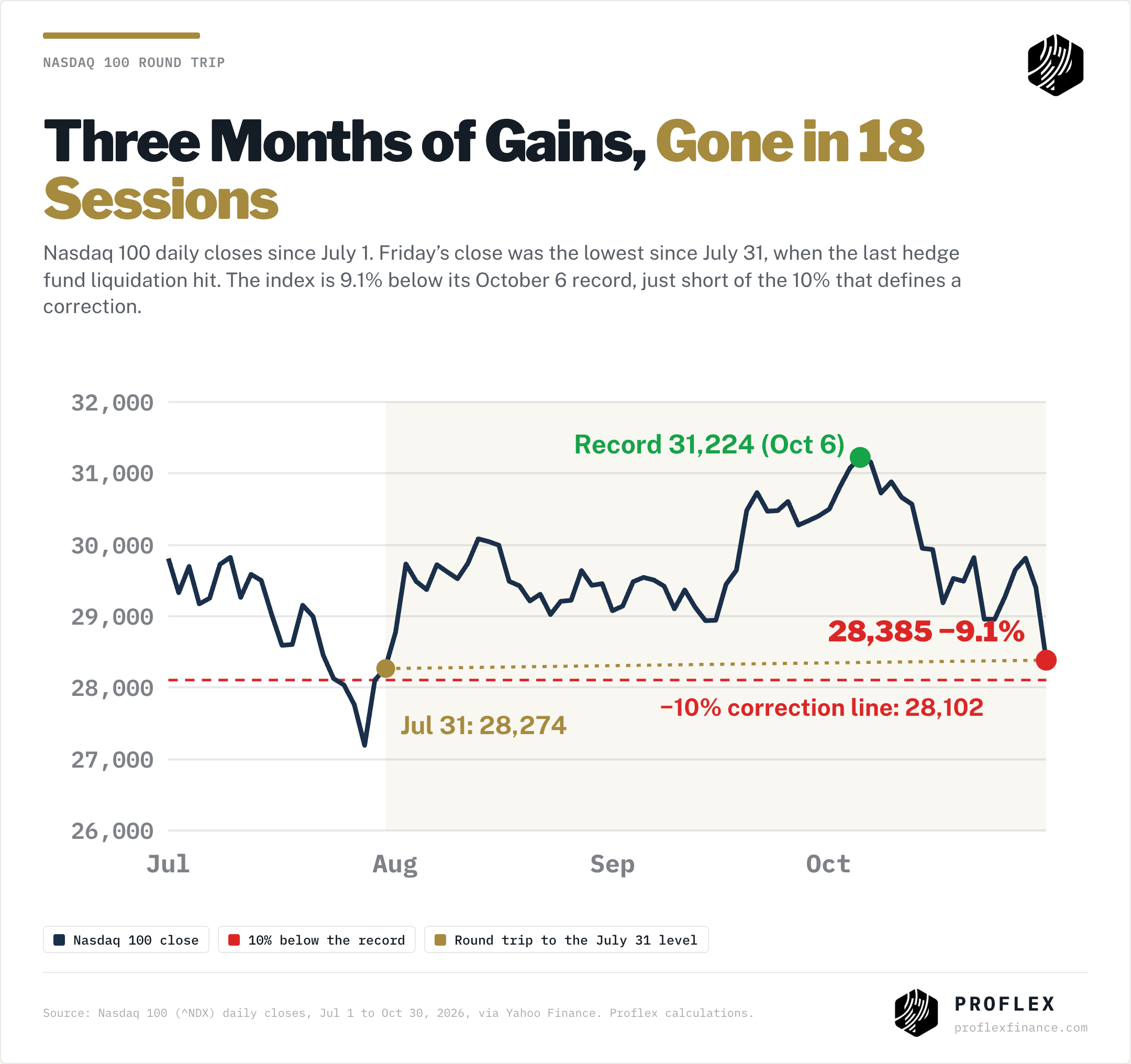
The week in 30 seconds ▸ Hedge funds cut exposure at the fastest pace in about a decade. The Nasdaq 100 finished 9.1% below its October 6 record, its lowest close since July 31. ▸ Intel fell 28.6% on Friday, its worst day since 1974. Leveraged chip ETFs spread the hit: the 3x SOXL lost 24.7% in a day. ▸ October split the market in two: energy +13.9%, staples +10.9%, semiconductors −14.2%. ▸ A $6.3 billion hack at Binance broke Bitcoin below $80,000. It is down only about 4% since. ▸ This week: the midterms on Tuesday, AMD the same night, the jobs report on Friday. Watch the full macro call →
The S&P 500 slipped 0.6% last week to 7,580, its third straight weekly loss, and the Nasdaq 100 fell 2.0% to 28,385. The damage came in two days. Alphabet fell 12.6% on Thursday after its results, and on Friday Intel’s outlook pulled the whole chip complex down. The semiconductor ETF (SMH) lost 8.0% in those two sessions. This is the week ahead, before we get into why.
Insights from the Proflex Macro Call
This is a positioning flush, not an earnings collapse. The hyperscalers grew cloud revenue faster and still fell, because funds that owned too much of them had to sell. The selling is about who holds the stocks, not what the companies earn.
The real story is memory. SK hynix says its DRAM and HBM supply is effectively sold out through 2029 and expects shortages to last into 2030. The same memory squeeze is what is crushing PC makers and Intel.
Leverage made it worse. Leveraged semiconductor ETFs have to sell all of their holdings when one stock drags the index. A miss in one PC chipmaker became a selloff in Nvidia, TSMC and AMD.
Be greedy, but slowly. The chip leaders now trade at multiples that price in a bust, while their order books say the opposite. The risk to that view is oil after the midterms.
Because the biggest holders sold. Strategists citing Morgan Stanley’s prime brokerage data say long/short funds cut gross exposure about 7.8% from the peak, the biggest cut in that data set since 2016. We could not find that number in a primary Morgan Stanley release, so treat the exact figure with caution. Goldman Sachs’ prime book points the same way: hedge funds sold off all of their net purchases of global AI stocks since early 2025 in five trading sessions (Hedgeweek).
The results did not justify a selloff of this size. Alphabet’s cloud revenue came in at about $30.7 billion, ahead of the $28.7 billion expected, yet the stock fell 12.6% because free cash flow turned negative (−$9.1 billion) and 2027 capex is going up. Amazon’s AWS grew 39% and the stock still fell 3.1% on the week. Combined capex at Amazon, Alphabet, Meta and Microsoft hit a record $201.9 billion in the quarter (The Kobeissi Letter).
Proflex View: When fund managers sell what they own most at the same time, prices fall for reasons that have nothing to do with the businesses. That is what made July 31 a buying opportunity, and the index is back at that level now. We are not calling the exact low. We are saying the selling looks forced.
How Did One Intel Guide Hit the Whole Market?
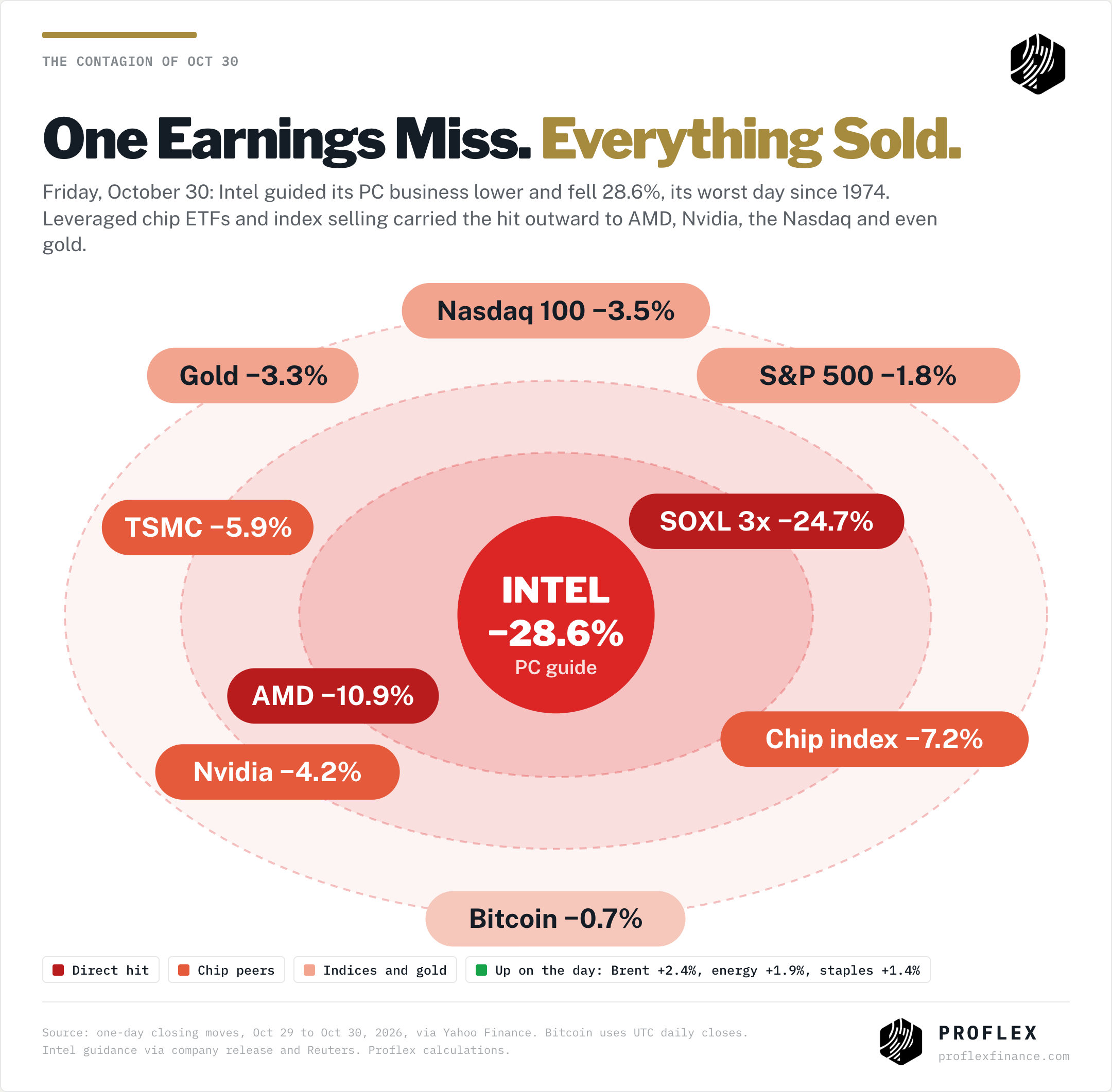
Intel beat on the third quarter and then guided fourth quarter revenue to $15 billion to $16 billion, with EPS of about $0.25 against roughly $0.43 expected. Reports say the company sees the PC market shrinking about 12% this year and another 10% in 2027, with memory costs a big part of the squeeze. The stock fell 28.6% to $65.76 on Friday and 45% in October.
Then leverage took over. Leveraged chip ETFs rebalance every day, so a crash in one large holding forces them to sell the rest of the basket. AMD fell 10.9%, TSMC 5.9% and Nvidia 4.2% on news that has little to do with AI data centres. The only things that rose on Friday were oil, energy, staples and utilities.
Proflex View: Intel’s problem is real, and it is a PC problem. The memory shortage that is squeezing PC makers is the same shortage that has SK hynix sold out through 2029. When the AI chip leaders fall on a PC warning, that is forced selling. We would add to them on that kind of weakness, not chase the defensives that already ran.
Where Did the Money Go?
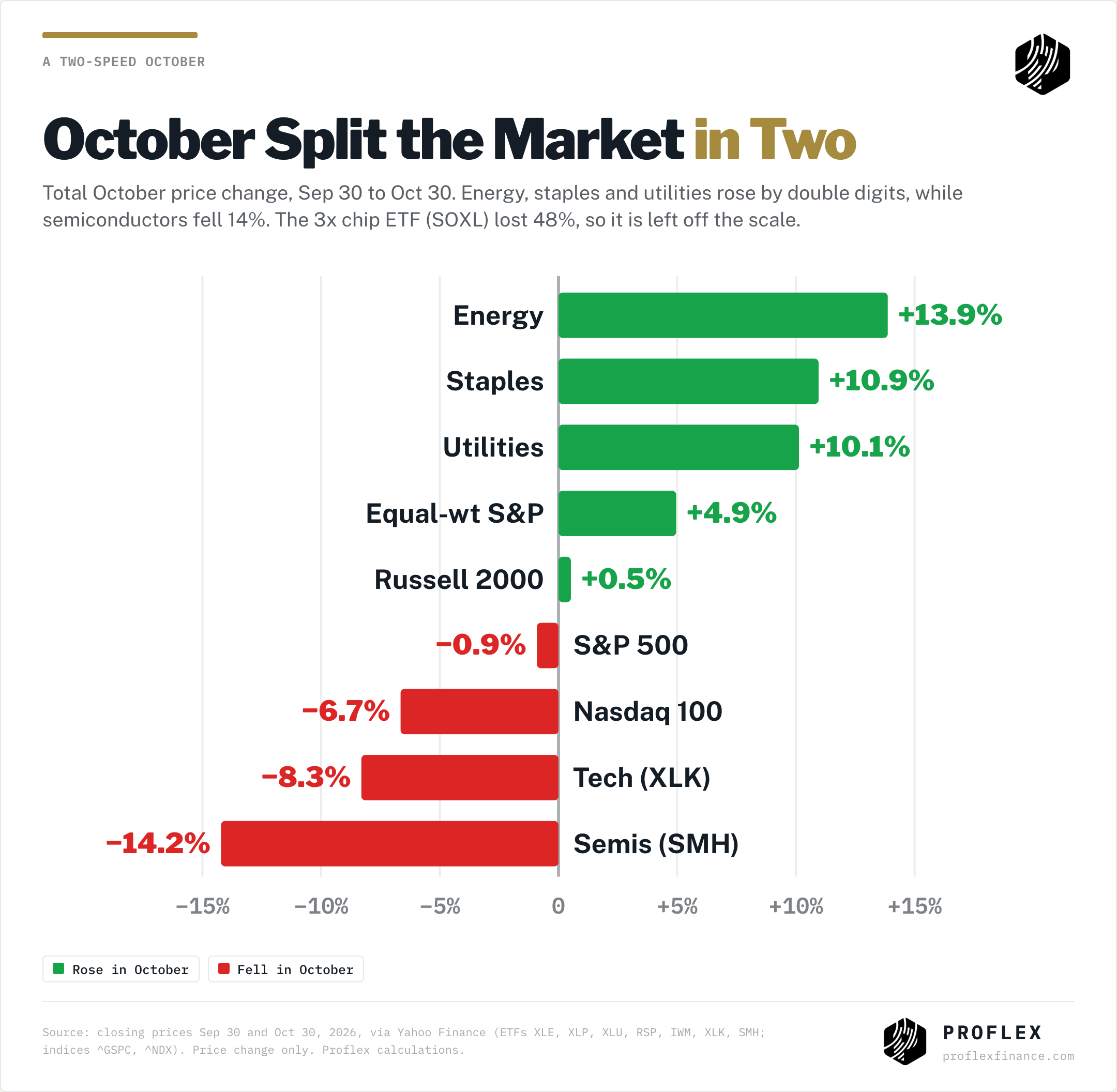
Into anything without an AI story. In October energy rose 13.9%, staples 10.9% and utilities 10.1%, and the equal weight S&P rose 4.9%. Semiconductors fell 14.2% and the 3x SOXL lost 48%. The S&P 500 itself fell only 0.9%, which hides how violent the rotation was underneath.
Valuations have moved the other way from the order books. Nvidia now trades at about 13 times forward earnings and Micron at about 4 times, while Nvidia added $150 billion to its buyback in September, for $235 billion in total. SK hynix earned an operating margin near 80% last quarter.
Proflex View: Defensives at 10% gains in a month are no longer cheap insurance. The chip leaders at the market’s lowest multiples are not priced for a boom. If you are rebalancing, this is the direction we would lean: trim what ran, add in steps to what fell.
Bitcoin, Gold and the Binance Hack
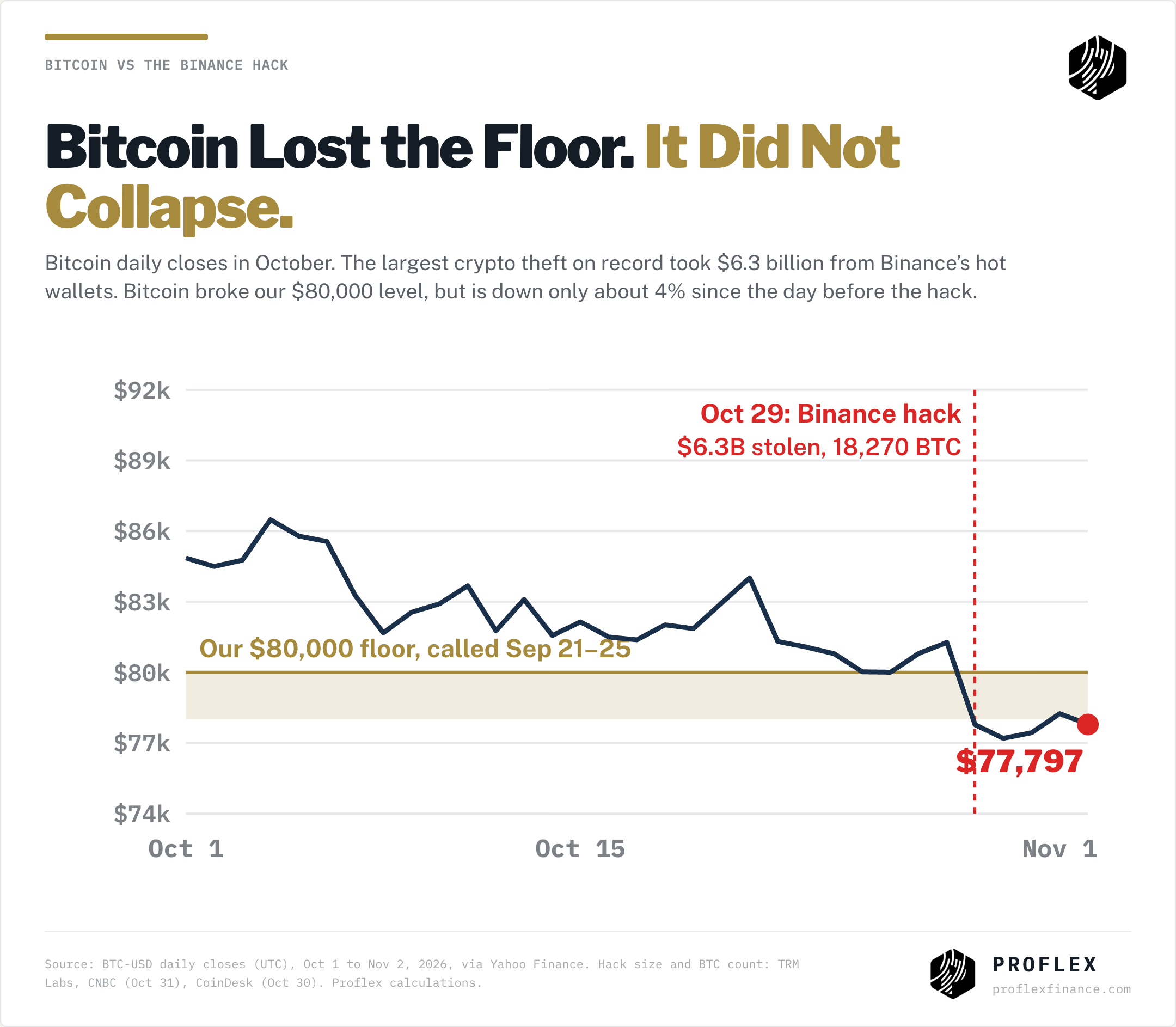
On October 29 attackers took about $6.3 billion from Binance’s hot wallets across ten blockchains, the largest crypto theft on record. TRM Labs attributes it to North Korea’s TraderTraitor group. About 18,270 BTC left one wallet, and $2.7 billion to $3 billion has been frozen. Binance resumed withdrawals on October 31 and says about 90% of user assets are covered.
Since late September we have called $80,000 the floor for Bitcoin. That level broke. But Bitcoin is down only about 4% since the day before the hack, a mild reaction to the biggest theft in crypto history. Gold fell 3.3% on Friday to $3,899, 17% below its August record. When gold falls on a risk-off day, someone is selling it to raise cash.
Proflex View: We were wrong on the $80,000 floor, and we are saying so. What matters now is that a $6.3 billion hack produced a 4% move. That is resilience, not panic. We would wait for Bitcoin to reclaim $80,000 on a closing basis before adding.
Oil and the Midterms: The Risk That Is Not Priced
Brent settled at $117.64 on Friday, within 2.3% of the $120 level we have named as the correction trigger since mid September. It then fell to $108.46 on Monday on reports of renewed US–Iran diplomacy. The 10 year yield eased to 4.93% and the VIX was 19.42.
Tuesday’s midterms are the swing factor. Our worry is that a tougher Iran policy becomes easier after the vote, and oil is the one input that could turn a valuation reset into a real downturn. Friday’s jobs report matters too: consensus is +55,000 after September’s +29,000, which missed the 90,000 forecast badly.
Proflex View: The election itself matters less than what it does to oil. Brent below $110 gives stocks room to recover. Brent back through $120 would be our signal to cut risk, whatever the earnings say.
🔍 What We’re Watching
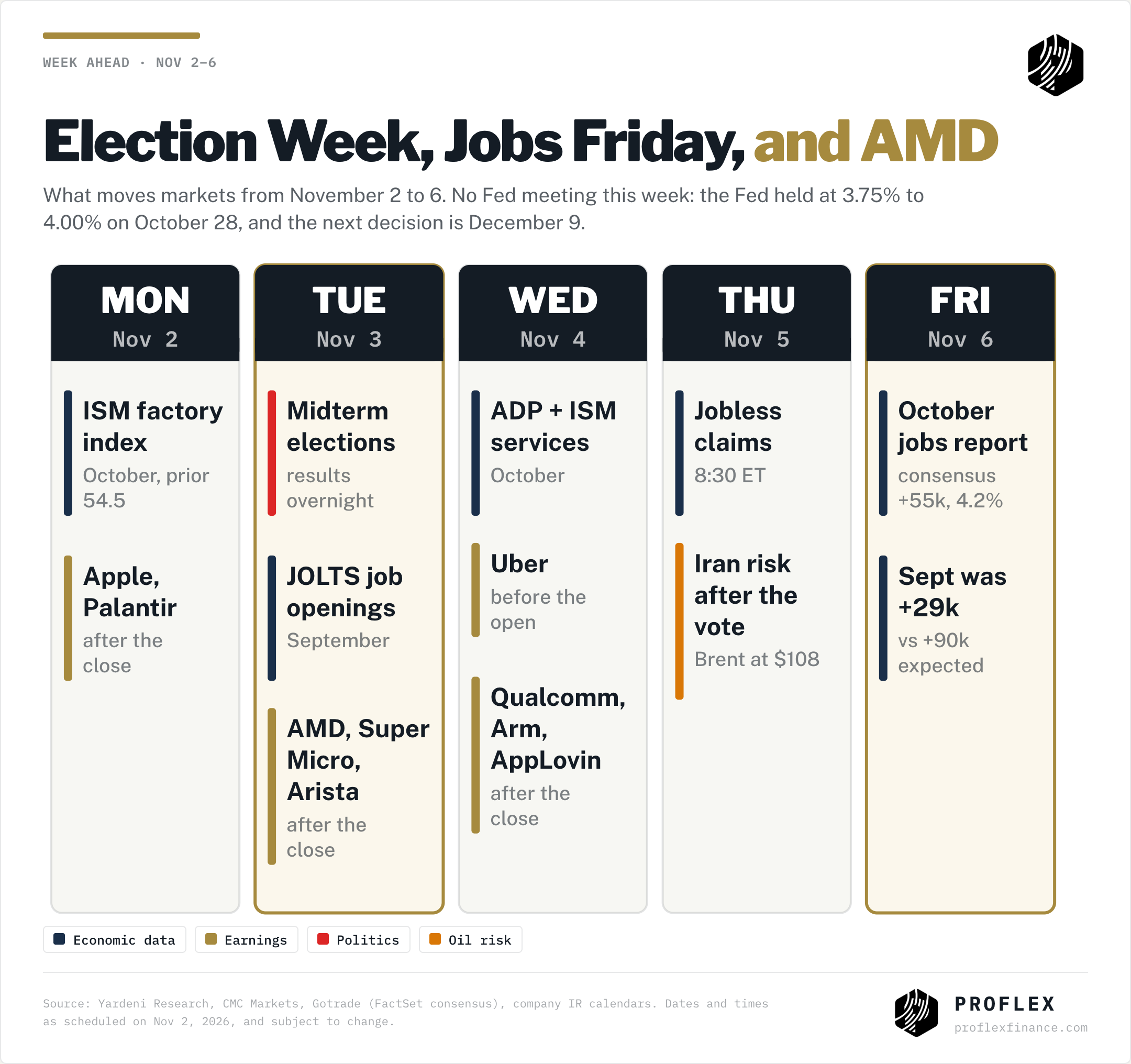
Apple after Monday’s close (EPS consensus $1.98), the last of the megacaps
AMD on Tuesday night: the first chip read since Intel. Data centre growth versus PC weakness is the whole story
The midterms on Tuesday, and what they mean for Iran policy and Brent
Qualcomm and Arm on Wednesday: two more reads on how deep the PC and phone slowdown runs
The October jobs report on Friday: consensus +55,000, unemployment 4.2%
Our levels: Nasdaq 100 against the 28,102 correction line, SMH reclaiming $540, Bitcoin reclaiming $80,000, Brent against $120
Your turn: Reply with the one ticker you want us to chart next week. The most requested one gets its own chart in the next edition. And if this edition helped, forward it to one person who owns too much tech.
🧭 Proflex Playbook – Be Greedy Slowly October was a positioning flush, not an earnings collapse. Hedge funds sold what they owned most, leveraged chip ETFs turned one Intel guide into a market-wide selloff, and even gold and Bitcoin were sold for cash. The businesses at the centre of the AI build out are still sold out into 2029. Add to the cash generative leaders in steps, keep leverage off the table during election week, and let Friday’s jobs report set the pace. Our conviction stays anchored in the data:
Focus on Structural Growth: Continue to overweight the secular AI theme, recognizing its multi-year runway.
Anticipate Shallow Corrections: Use dips as accumulation opportunities, not reasons for fear, understanding that "none of the corrections stick."
Diversify Thoughtfully: Recognize the "decorrelation" across asset classes; consider gold, silver and Bitcoin for portfolio resilience.
Develop Mental Models: Prioritize long-term planning (6-12 months out) over short-term news, aiming for consistent, incremental gains.
If you're an All-Access or Managed Portfolio subscriber, our positioning has already shifted ahead of this moment—scaling up asymmetric hard asset plays while hedging for earnings volatility and geopolitical tail risks.
Proflex All-Access: Your Market Compass
Explore the financial markets with Proflex All-Access, your comprehensive resource for deeper market understanding and active participation. This premium service offers subscribers exclusive insights and actionable investment advice, giving you a significant edge in various market conditions.
Proflex All-Access provides detailed analyses and recommendations to optimize your investment strategy. Our specialized newsletters include:
• Growth Gazette (Contains Crypto Pulse) : Aimed at achieving above-market returns for aggressive portfolio growth.
• Income Insider: Focused on conservative strategies and income generation for yield-seeking investors.
Until next week, — The Proflex Team Trusted Macro Insights. Calm Investing. Tactical Trades.
Elevate your financial IQ
ProFlex® by Blockstart Research Legal Disclosures
ProFlex® by Blockstart Research, the premium newsletter product series, provides informational and educational content only and does not offer personalized investment advice or establish a fiduciary relationship. While we rely on reliable sources and research, the information is not tailored to individual financial situations. Readers are urged to consult qualified financial professionals before making investment decisions. We do not guarantee the accuracy, completeness, or timeliness of the information and are not responsible for any investment decisions based on this newsletter. Investing carries risks, and past performance doesn't predict future results. By accessing this newsletter, you acknowledge that we are not liable for actions or decisions resulting from its content. Please conduct due diligence and seek professional advice as needed.
Proflex Institutional Research Series
Elevate Your Investment Game!
ProFlex® is designed to optimize your time, ignite your investment IQ, and maximize your financial potential.