ProFlex® is designed to optimize your time, ignite your investment IQ, and maximize your financial potential.
Proflex Aug 10-14 — AI Numbers Keep Improving, SPY New Highs, Anthropic IPO Derisks Semis
|
Proflex Market Update — Week Aug 10-14, 2026 AI Numbers Keep Improving | SPY New Highs, Tech to Follow | Anthropic IPO Derisks Semis | Iran Stalemate Drags On
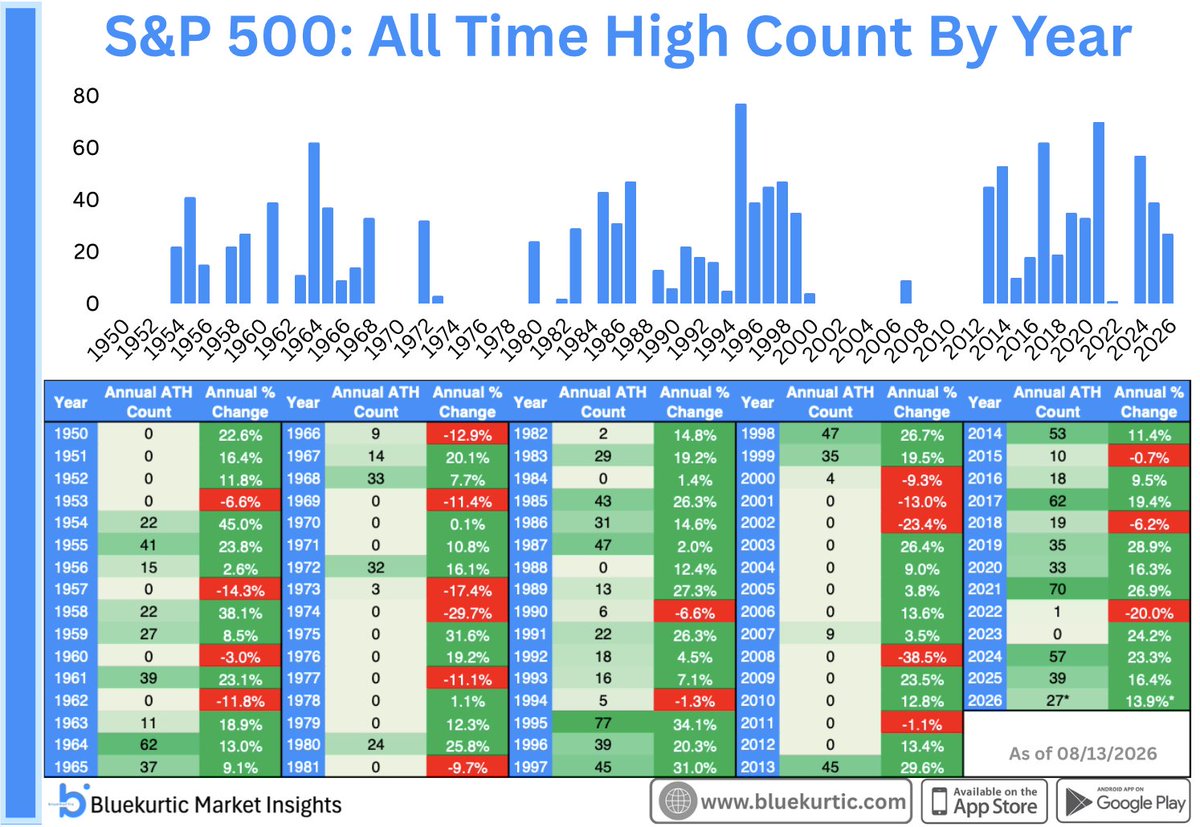
"The market is too pessimistic about AI at the exact moment every revenue line, every booking metric, and every utilization rate is accelerating. New highs in the S&P are not the end of the rotation: they are the beginning of it flowing back into tech." — Proflex Panel The S&P 500 closed last week at a fresh all-time high of 7,799, its 27th record close of 2026, with the intraday peak touching 7,817 on Wednesday.
And yet the conversation around AI remains stubbornly skeptical. The "capex bubble" narrative that drove semiconductors down 28.7% from their June 22 peak has not been disproven. Our view: the S&P making new highs is the precondition. Broad market strength historically pulls technology back toward leadership within 4 to 6 weeks. The SOX has already recovered 18.9% off its July 29 trough. That said, the path is not clean. Leverage remains elevated, the Strait of Hormuz MoU expired today without extension, and the FOMC July minutes on Wednesday could reintroduce volatility. Discipline matters more than direction this week. The Proflex 50-Page Research Thesis on AI Trade : Opportunity or Bubble (Link Below) We have put the entire argument into one place. How AI is oscillating between the biggest opportunity and the biggest bubble of this decade is our detailed research note on how to think about this, with the real numbers behind it: the capex to revenue gap, the private lab economics, the depreciation debate, the circular financing map, and a direct comparison against dot com era valuations rather than dot com era vibes. Download the Proflex Research Report here
The single most valuable thing an investor can own in this market is a framework for distinguishing the AI that is generating cash from the AI that is generating commitments. Key Drivers This Week The AI Revenue Acceleration: Why the Market Has It Wrong The dominant Wall Street narrative since early July has been that hyperscaler capital expenditure is outrunning revenue, that the AI trade is the next dot com, and that semiconductor valuations need to compress. The data says something different. Combined Q2 2026 hyperscaler capex came in at $165 billion, up 87% year over year. That is a large number in isolation. But set it against the revenue trajectory and the picture changes:
The capex is large because the revenue opportunity is larger. Barclays projects Big 5 hyperscaler capex will reach $919 billion in 2027 and $1.16 trillion in 2028, both figures above current Street consensus by more than $225 billion. NVIDIA trades at a forward P/E of roughly 23x while delivering data center growth above 90% at 75% gross margins. That multiple is below the broader semiconductor median of 32x.
Proflex View: The market is too pessimistic about AI because it is anchoring to the balance sheet stress (rising capex, compressed free cash flow) while ignoring the income statement inflection (triple digit revenue growth, expanding run rates, contracted and sold out capacity through 2027). Every quarter that passes without a demand air pocket makes the "bubble" thesis harder to sustain. NVIDIA on August 26 is the next proof point: if data center revenue comes in above the $91 billion guide, the rotation back into semis accelerates meaningfully. SPY at All-Time Highs: Why Tech Follows the Broad Market Higher The S&P 500 has now printed 27 all-time highs in 2026. The Russell 2000 hit its own record on Thursday. Breadth is broadening: homebuilders gained 9.4% over the past month, healthcare 8.4%, insurance 6.4%. This is not the kind of tape that precedes a technology collapse. Historically, when the S&P makes sustained new highs with improving breadth and a falling dollar, the lagging growth sectors (semiconductors, software, mega cap tech) tend to catch up within one to two months. The SOX bottomed at 10,445 on July 29 and closed last week at 12,417, a recovery of 18.9% in 12 trading sessions.
Proflex View: As we wrote two weeks ago, "the fundamentals did not break, the leverage did." The S&P's new highs are the mechanism through which tech re-rates. With the VIX at 14.25 and dealer gamma positioning turning positive, the structural support for a continued grind higher is in place. The risk is not that tech fails to follow. The risk is that the path there is bumpy: volatility can spike from currently suppressed levels, and high leverage on the upside creates the same fragility it did on the downside. The Anthropic IPO: Why It Derisks the Semiconductor Trade Anthropic confidentially filed its S-1 on June 1 and is targeting an October 2026 IPO at a valuation north of $2 trillion. The company's annualized revenue run rate stands at approximately $74 billion (as of Jul 2026).
Why this matters for semiconductors: every dollar Anthropic raises is a dollar committed to compute. The company's projected revenue of $190 to $200 billion by fiscal 2028 requires massive ongoing GPU and memory procurement. TSMC has raised its 2026 capex budget to $60 to $64 billion (from $52 to $56 billion), reflecting confidence in sustained demand. SK Hynix delivered Q2 revenue of KRW 79.3 trillion (up 257% year over year).
Proflex View: A successful Anthropic IPO in October would be the single most important derisking event for the semiconductor trade since NVIDIA's Q1 results in May. It converts the abstract "$2 trillion private AI valuation" from a liability (what if it is wrong?) into a publicly priced asset (the market says it is real). Watch the roadshow and pricing closely: if institutional demand is strong, the bid under NVDA, AVGO, and the memory complex firms materially.
Caution: Leverage, Volatility, and the Bumpy Road to New Highs New highs are not the same as easy gains. The VIX at 14.25 is in the bottom quartile of its historical range, and from these levels, mean reversion spikes tend to be sharp and sudden. The last time volatility was this compressed in 2026, the June 22 selloff erased $3.3 trillion from semiconductors in a single session. Several structural risks deserve heavy scrutiny this week:
Proflex View: We remain constructive on the direction but cautious on the amplitude. Leverage at compressed volatility levels creates fragility in both directions. The FOMC minutes, Nvidia earnings (August 26), and the Iran situation are three catalysts that could individually spike the VIX from current levels in a single session. Position for the trend, but hedge the event risk.
The Week Ahead: Light Data, Heavy Parsing US economic data is on the lighter side next week in terms of importance with FOMC minutes on deck.
No Fed speakers are scheduled for the week, but the minutes effectively serve as the Fed's voice. Jackson Hole follows the next week (August 27 to 29), so any hawkish signal in the minutes gets amplified by proximity to the symposium. Earnings are in the wind-down phase with just 12 S&P 500 components reporting, but the batch has a distinct retail focus: Walmart (WMT), Home Depot (HD), TJX, Deere (DE), Lowe's (LOW), and Analog Devices (ADI) lead by earnings weight. Combined revenue above $100 billion will offer the clearest read on consumer spending health we have had since Q1. Iran: Stalemate Deepens, Kalshi Odds at New Lows As we said ten weeks ago, "we'll just have to see how things progress." The progress has been backward. The 60 day Memorandum of Understanding expired today without agreement or extension. Kalshi odds that Strait traffic normalizes by year end had risen as high as 86% on June 24. Offsetting the rhetoric, Oman-mediated technical talks on a limited safe-transit route are reportedly in "final stages," and Brent has consolidated at $88, well below the $138 April peak. Trump stated on Fox News today that he is "not in a hurry" to reach a deal and threatened to "bomb" Oman if it interferes with US operations.
Proflex View: The Iran situation remains exactly what it has been for ten weeks: fluid, unresolved, and unlikely to produce a clean resolution before the midterms. Brent at $88 suggests the physical oil market has largely adapted, but the geopolitical premium remains an overhang on sentiment. For portfolio purposes, the Iran tail risk is already priced: it would take a meaningful escalation (direct strike on Saudi or UAE infrastructure, naval confrontation with a US carrier group) to move oil materially from here. The bigger risk this week is domestic (FOMC minutes), not geopolitical. 🧭 Proflex Playbook – Buy the Progression, Not the Narrative
Proflex All-Access: Your Market Compass
Explore the financial markets with Proflex All-Access, your comprehensive resource for deeper market understanding and active participation. This premium service offers subscribers exclusive insights and actionable investment advice, giving you a significant edge in various market conditions.
Proflex All-Access provides detailed analyses and recommendations to optimize your investment strategy. Our specialized newsletters include:
• Growth Gazette (Contains Crypto Pulse) : Aimed at achieving above-market returns for aggressive portfolio growth.
• Income Insider: Focused on conservative strategies and income generation for yield-seeking investors.
ProFlex® by Blockstart Research
Legal Disclosures ProFlex® by Blockstart Research, the premium newsletter product series, provides informational and educational content only and does not offer personalized investment advice or establish a fiduciary relationship. While we rely on reliable sources and research, the information is not tailored to individual financial situations. Readers are urged to consult qualified financial professionals before making investment decisions. We do not guarantee the accuracy, completeness, or timeliness of the information and are not responsible for any investment decisions based on this newsletter. Investing carries risks, and past performance doesn't predict future results. By accessing this newsletter, you acknowledge that we are not liable for actions or decisions resulting from its content. Please conduct due diligence and seek professional advice as needed.
|


Proflex Institutional Research Series
ProFlex® is designed to optimize your time, ignite your investment IQ, and maximize your financial potential.